About Pieris bryoniae (Hübner, 1806)
Scientific name: Pieris bryoniae (Hübner, 1806)
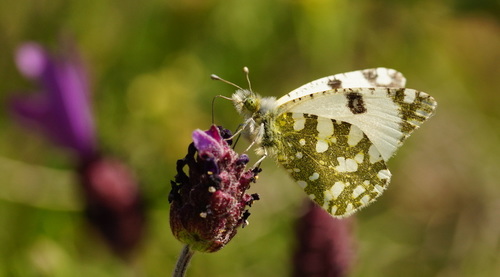
Description and Differentiation: The Seitz form of bryoniae (21c) inhabits the Alps, Northern Scandinavia, and the mountains of Asia Minor. Males of this form have rather narrower wings than male Pieris napi, and bear no markings on the upper side of the forewing except blackish apical and basal areas. Females have a yellowish ground colour, which is more or less obscured by the extensive dark scaling along the veins.
Among females, there are specimens where the discal spots and vein streaks of the forewing are strongly reduced, leaving no prominent markings; this form is named ab. obsoleta nov. Individuals where the yellowish ground colour, especially on the forewing, is almost entirely obscured by more extensive dark scaling can be named ab. concolor nov.
The form kamtschadalis Bang-Haas i. l. from Kamchatka has females that are somewhat paler than nominate bryoniae, with less sharply marked forewing discal spots and much paler underside of the hindwing. The form sifanica Gr.-Grsh. from Amdo is nearly as large as Pieris melete orientis; in males, the veins are broadly edged with greenish black on the underside. It has not yet been confirmed whether sifanica is truly distinct from orientis.
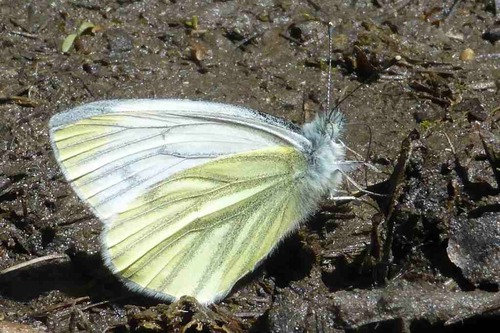
The main difference between this species and phylogenetically similar species (Pieris napi, Pieris ergane, Pieris rapae) is that the wing veins of this species are much more prominent on both wings, particularly on the upper wing surface. Females have a base colour ranging from yellowish to greyish-brown. In some cases, males are almost indistinguishable from females, as sexual dimorphism is nearly absent. Some specimens have a blackish-grey band along the entire outer margin of the forewing. On the hindwing, vein endings may widen to form dark triangular markings. Summer generations are paler than spring generations; generally, forewings are paler than hindwings and also have less prominent veins. Other less obvious morphological characteristics are currently under discussion among entomologists, as their relevance only appears in restricted populations.
Wingspan ranges between 4 and 4.4 cm. Females of Pieris napi from Ireland are often heavily marked, but Langham (1922) failed to find Pieris bryoniae in Ireland. The type locality of the nominate form is the Alps, where it occurs at considerable altitudes up to 2000 m and produces only one generation per year. Both pairs of the female's wings are dark in this high-altitude population. At lower altitudes, two or three generations emerge per year.
Subspecies neobryoniae closely resembles Carpathian populations, and occurs in the southern Alps, while subspecies flavescens Wagner inhabits the northern Alps. The ground colour of its wings is yellowish or rich yellow, often with a mauve gloss. Populations inhabiting the Carpathians are very varied. The most distinct is subspecies vihorlatensis, found in Vihorlat, the east Slovak mountains. Other subspecies are listed with their type localities: Pieris bryoniae adalwinda Fruhstorfer, 1909, Norway, Porsanger; Pieris bryoniae bicolorata (Petersen, 1947), Schweden, Murjek; Pieris bryoniae bryonides Sheljuzhko, 1910, Russia; Pieris bryoniae caucasica Lorkovic, 1968, NW Kaukasus; Pieris bryoniae carpathensis Moucha, 1956, East Carpathians, Osa; Pieris bryoniae flavescens (Müller, 1933), Austria, Mödling, Wien; Pieris bryoniae kamtschadalis (Röber, 1907), Kamtschatka; Pieris bryoniae lorcovici Eitschberger, 1983, Juliske Alpe, Vršic (North), 1400–1600 m; Pieris bryoniae marani Moucha, 1956, Slovakia, Zadiel Tal; Pieris bryoniae schintlmeisteri Eitschberger, 1983, USSR, Jakutia, Tommot; Pieris bryoniae sheljuzhkoi Eitschberger, 1983, Omsukchan, Magadan Gebiet; Pieris bryoniae sifanica (Grum-Grshimailo, 1895), Amdo; Pieris bryoniae turcica Eitschberger & Hesselbarth, 1977, Turkey, Anatolia, Ilgaz dagh-Pass, 1800 m; Pieris bryoniae vitimensis (Verity, 1911), Russia, Vitim; Pieris bryoniae wolfsbergeri Eitschberger, 1983, Italia, Piemonte, Terme di Valdieri, S. Giovanni, 1500 m.
Occurrence and habitat: The species occurs in the Alps, the Fatra (Slovakia), the High Tatras, the Carpathians, parts of Turkey, the Caucasus, the Tian Shan and the Altai. Its altitudinal distribution ranges between 800 and 2700 metres. Typical habitats are mountain meadows and flower-lined stream banks. In regions where the ranges of P. napi and P. bryoniae overlap, P. napi × P. bryoniae hybrids can form. Due to the inherited migratory behaviour of P. napi, these hybrids are occasionally found outside the actual range of P. bryoniae. These hybrids are usually not capable of reproduction.