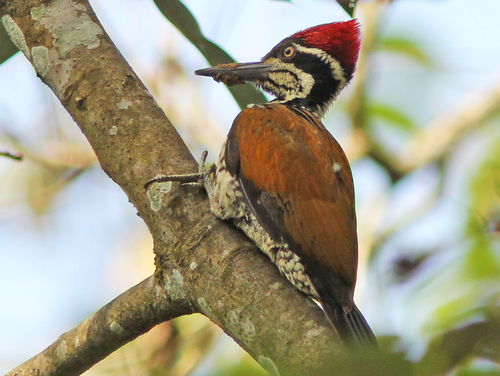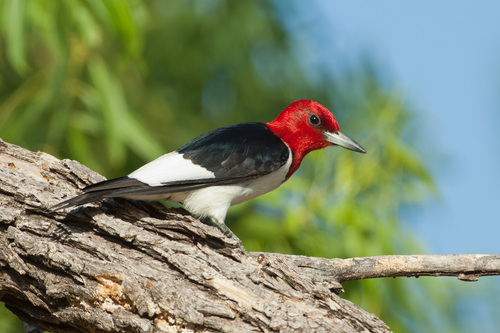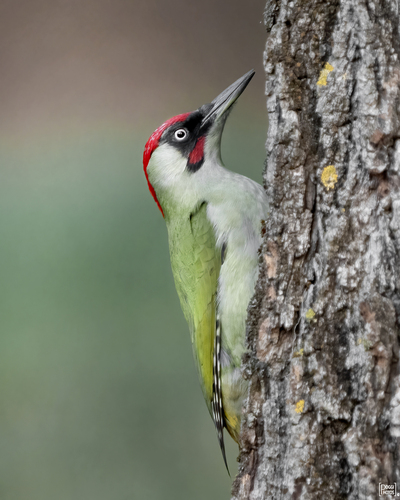
About Picus viridis Linnaeus, 1758
The European green woodpecker, with the scientific name Picus viridis Linnaeus, 1758, is 30–36 cm (12–14 in) long and has a 45–51 cm (18–20 in) wingspan. Adults of both sexes have green upperparts, pale yellowish green underparts, a yellow rump, and a red crown and nape. The male’s moustachial stripe has a red centre, while the female’s is entirely solid black. For both sexes, the area around the white eye and the lores is black; this is not true for the Iberian subspecies P. v. sharpei, which has dark grey lores and eye area, and where males only have a black lower border to the moustache. Juveniles are spotted and streaked across their whole body, and their moustache is dark at first. Juvenile males may grow some red feathers by early June, or more usually by July or August. Moult occurs between June and November, and the first flight feathers are lost around the time young birds fledge. Juveniles moult quickly after fledging and grow their full adult plumage between August and November. Although the European green woodpecker is shy and wary, it is most often first noticed by its loud calls called yaffling. It drums rarely, producing a soft, fast roll, but often calls with a noisy kyü-kyü-kyück while flying. Its song is a loud series of 10–18 'klü' notes that speeds up slightly and drops slightly in pitch toward the end. Females produce a thinner repeated pü call. Its flight is undulating: it does 3–4 wingbeats then holds its wings against its body for a short glide. It can be told apart from the smaller, similar grey-headed woodpecker by its yellowish (not grey) underparts, and its black lores and facial mask. In Europe, its green upperparts and yellow rump can lead to confusion with the grey-headed woodpecker or the female golden oriole; the female golden oriole is smaller, more slender, with narrower wings and a longer tail. The very similar, closely related Levaillant's woodpecker is only found in north-west Africa. Over 75% of the European green woodpecker’s total range lies within Europe, where it is absent from some northern and eastern areas, Ireland, Greenland, and the Macaronesian Islands, but is widely distributed across the rest of the continent. More than half of the European population is estimated to live in France and Germany, with substantial populations also present in the United Kingdom, Sweden, Russia, Croatia, Romania and Bulgaria. The species also occurs in western Asia. It has a large range, with an estimated global extent of occurrence between 1 million and 10 million square kilometres, and a total population estimated at 920,000 to 2.9 million birds. Its populations are stable, so the species is classified as Least Concern. The European green woodpecker is highly sedentary, and individual birds rarely move more than around 500 metres between breeding seasons. To survive, the species requires two key things: old deciduous trees for nesting, and nearby feeding grounds with large numbers of ants. This combination of conditions is usually found in semi-open landscapes that include small woodlands, hedges, scattered old trees, forest edges, and floodplain forests. Suitable foraging habitats include grassland, heaths, plantations, orchards and lawns. The main food of the European green woodpecker is ants from the genera Lasius and Formica. It spends much of its time foraging for these ants on the ground, though it will also eat other insects and small reptiles occasionally. The species’ distinctive, elongated, cylindrical droppings often consist entirely of ant remains. At ant nests, it probes into the ground and licks up adult ants and their larvae. Its tongue wraps around to the back of its head. A study of a nest in Romania found that chicks were fed 10 different ant species. During the first 10 days of life, each young bird received an average of 15 g (0.53 oz) of food per day; between days 10–20 this was 39.5 g (1.39 oz), and from day 20 onward it was 49.3 g (1.74 oz). The seven chicks in the study ate an estimated 1.5 million ants and ant pupae before leaving the nest. The European green woodpecker’s beak is relatively weak, and is only used for pecking soft wood. Like other woodpecker species, it has a long 10 cm tongue that must be curled around its skull. It does not have the barbs found on the tongues of Dendrocopos woodpeckers and the black woodpecker (Dryocopus martius), but its tongue is made sticky by secretions from enlarged salivary glands. Long, heavy snow cover makes feeding very difficult for this species and can cause high mortality, and it may take ten years for local populations to recover from such an event. Ant nests can be located even under snow; one bird was recorded digging 85 cm deep to reach an ant nest.