About Picumnus squamulatus Lafresnaye, 1854
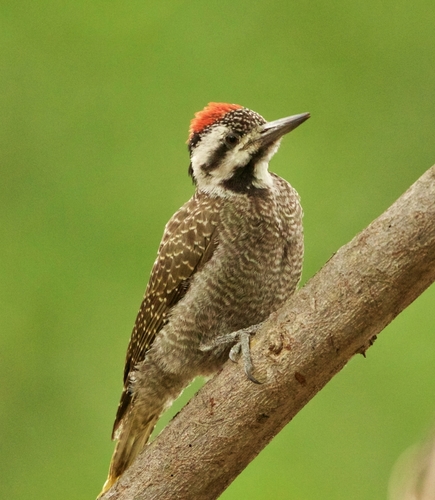
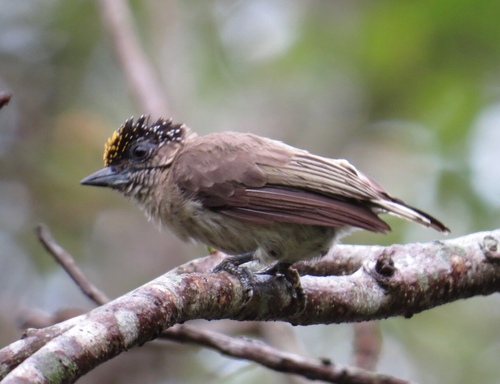
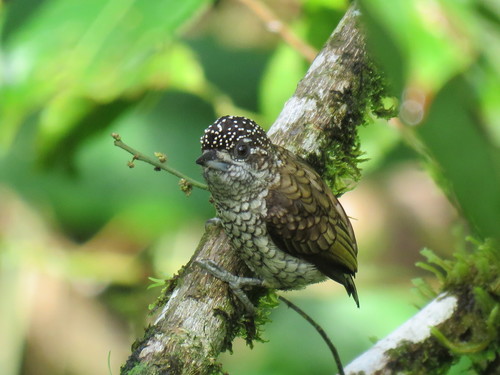
Description: The scaled piculet measures 8 to 9.2 cm (3.1 to 3.6 in) in length and weighs 7 to 12 g (0.25 to 0.42 oz). For adults of the nominate subspecies P. s. squamulatus, males have a black cap: the forehead has red-tipped feathers, and the rest of the cap has white-tipped feathers. Their face is mostly brown, with black tips on some feathers and a whitish line behind the eye. Their upperparts are olive brown, with a distinct scaly appearance caused by narrow black borders on each feather. Their flight feathers are brown, with yellowish edges along the secondaries and tertials. Their tail is brownish black; the innermost pair of tail feathers have mostly white inner webs, and the outer two pairs have a white patch near the tip. Their chin and throat feathers are white with narrow gray-brown tips. The rest of their underparts are whitish, with scaly markings that match the pattern on the upperparts. Adult females are identical to males except that the entire crown has white spots. Juveniles have darker upperparts than adults, and the scaly pattern on their underparts is more diffuse. Subspecies P. s. roehli often has yellow or orange forehead spots instead of red, has brighter upperparts than the nominate subspecies, has a brownish yellow tinge on the belly, and has narrower markings on the underparts. Subspecies P. s. lovejoyi always has yellow forehead spots, and its upperparts are grayer than the nominate's. Subspecies P. s. obsoletus has a yellow-green tinge on its upperparts, yellowish white underparts with paler, finer scale markings, and dark streaks in the center of each feather. Subspecies P. s. apurensis has whiter underparts than the nominate, and its scaly markings are narrow and indistinct. The vocalization of the scaled piculet is a high-pitched squeaky 'chi-chi-ch'e'e'chi' that becomes trill-like at the end. Distribution and habitat: The scaled piculet lives in a range of semi-open to open landscapes, including gallery forest, primary forest edges, secondary forest, deciduous woodland, farmland with scattered trees, and pastures. It occurs at elevations up to 1,900 m (6,200 ft). As currently documented, the scaled piculet is a year-round resident across its entire range. Food and feeding: The scaled piculet eats small insects. It forages on thin branches and twigs within dense vegetation or small trees, usually alone or in pairs.