About Picumnus nebulosus Sundevall, 1866
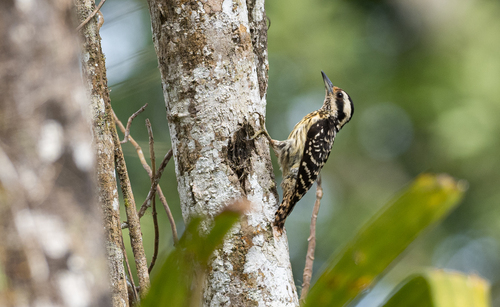
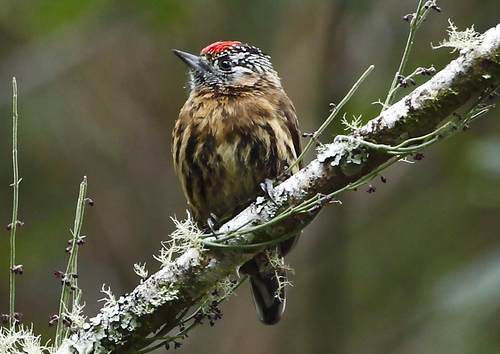
The mottled piculet (Picumnus nebulosus Sundevall, 1866) measures 10 to 11 cm (3.9 to 4.3 in) long and weighs 11 to 12 g (0.39 to 0.42 oz). Adult males have a black cap and nape, with a red patch on the forehead and white spots on the rest of the cap and nape. Their face is mostly dark olive-brown, with some white areas. Their hindneck and upperparts are warm olive-brown, and their back has a buff or rusty tinge. Their flight feathers range from dark brown to blackish, with wide pale edges on the secondaries and tertials. Their tail is black: the innermost pair of tail feathers have mostly white inner webs, and the outer three pairs have a white streak on the outer web. Their chin and throat are white with thin black bars. Their breast is buffish brown, and sometimes has dark streaks. Their belly is pale buff, and their flanks are a richer buff with wide blackish streaks. Their iris is brown, the orbital ring is grayish, the beak is black with a gray base to the mandible, and the legs are gray. Adult females are identical to males in appearance, except their entire cap has white spots and they have no red patch. Juveniles are duller in color than adults, and have a dull brown crown with pale buffish streaks. The mottled piculet has a distinct limited range. It occurs from Paraná state in southeastern Brazil southward through eastern Uruguay, and into the Misiones and Corrientes provinces of Argentina. Its typical habitat is lowland evergreen Atlantic forest and Araucaria forest, but it can also be found in gallery forest, bamboo thickets, scrubland, and wooded savannah. It mostly occurs at elevations up to 1,100 m (3,600 ft), but has been recorded as high as 1,400 m (4,600 ft).