About Picumnus lafresnayi Malherbe, 1862
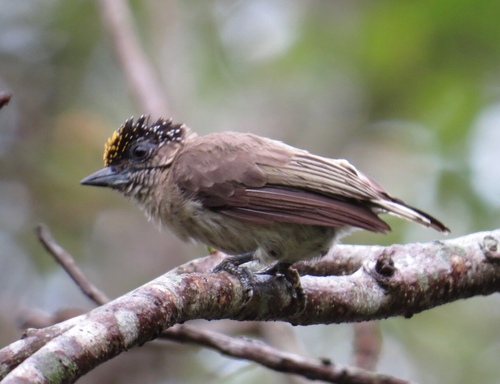
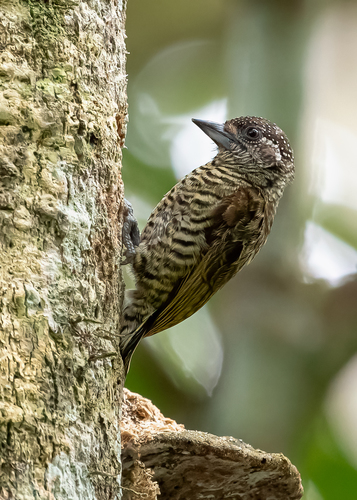
Lafresnaye's piculet (Picumnus lafresnayi Malherbe, 1862) measures 9 to 10 cm (3.5 to 3.9 in) long and weighs 9 to 10 g (0.32 to 0.35 oz). For the nominate subspecies P. l. lafresnayi, adult males have a dark olive-brown cap, with red spots on the forehead and whitish spots on the rest of the cap and the nape. Their face is grayish buff with brown streaks or spots, and a pale stripe runs behind the eye. Their upperparts are dark green or brownish green with yellowish green bars. The upper side of their tail is blackish; the innermost pair of feathers have mostly white inner webs, and the outer three pairs have a large white area near the tip. Their chin and throat are buffish white with narrow black marks. Their underparts are pale yellowish white with wide black bars. Adult females are identical except that they have whitish spots across their entire crown. Juveniles are similar to adults, but are duller overall, greener on the upperparts, and have less even barring on the underparts. The other three subspecies of Lafresnaye's piculet have yellow-orange spots on the forehead, instead of the red spots seen on the nominate subspecies. Additionally, P. l. punctifrons has a darker face and narrower bars on the underparts than the nominate. P. l. taczanowskii has a blacker crown and wider, more irregular dark barring on the underparts. P. l. pusillus has a slight rufous tinge to its upperparts, narrow dark bars on its underparts, and a mostly unbarred center of the belly. The four subspecies of Lafresnaye's piculet have separate distribution ranges: P. l. lafresnayi is found from southeastern Colombia south through eastern Ecuador to Peru's Department of San Martín; P. l. punctifrons is found in Amazonas Department in northern Peru; P. l. taczanowskii is found in northeastern and north-central Peru, between the departments of Huánuco and Ayacucho; P. l. pusillus is found in north-central Brazil, along the middle Amazon east to the Rio Negro. Lafresnaye's piculet inhabits edges and clearings of humid mature forest, as well as secondary forest. Most individuals are found up to an elevation of 1,400 m (4,600 ft), but the species occasionally occurs as high as 1,800 m (5,900 ft) in Ecuador.