About Picumnus granadensis Lafresnaye, 1847
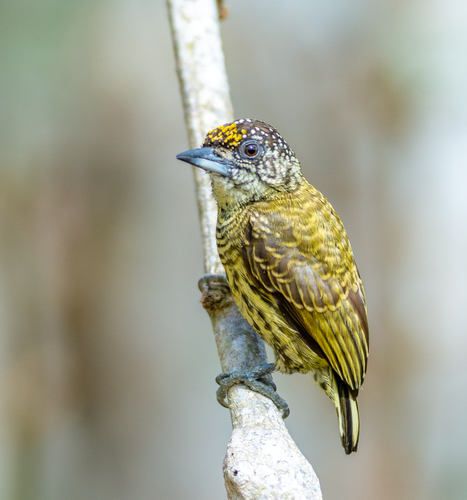
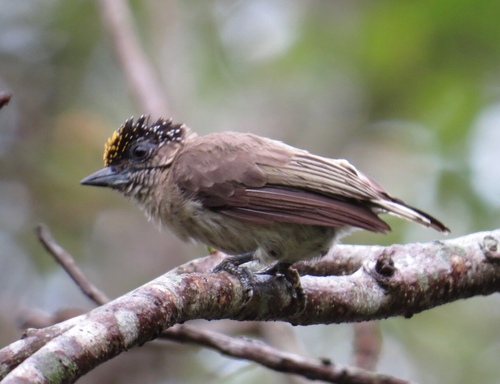
The greyish piculet (Picumnus granadensis Lafresnaye, 1847) is 9 to 10 cm (3.5 to 3.9 in) long and weighs 12 to 13 g (0.42 to 0.46 oz). For adult males of the nominate subspecies, the crown and nape are black, with small yellow tips on feathers of the front and top of the crown, and white spots on the remaining crown and nape feathers. Their ear coverts are chestnut brown with a few white streaks; their cheeks are off-white with blackish feather tips; the sides of their neck are gray-brown with white spots or streaks. Their hindneck and upperparts are grayish brown, and often carry an olive tinge. Their flight feathers are dark brown with yellowish green edges. Their tail is dark brown; the innermost pair of tail feathers have white inner webs, and the outer two pairs have a white stripe. Their chin and throat are off-white with blackish feather tips. Their underparts are dull white, and the flanks sometimes have fine grayish streaks. Their iris is brown, their beak is black, the bare skin around their eye is gray-blue, and their legs are gray with a green or blue tinge. Adult females are identical to males except they have white spots across their entire crown and no yellow. Juveniles are duller and darker than adults, and have more heavily streaked underparts. The subspecies P. g. antioquensis has grayer upperparts and more obvious gray streaking on the belly and flanks than the nominate subspecies. The more northern of the two subspecies is P. g. antioquensis, which is found in northwestern Colombia on the western slope of the Western Andes, between Antioquia Department and the upper reaches of the Rio San Juan. The nominate subspecies occurs in western Colombia, from the middle and upper reaches of the Rio Cauca south to the upper Rio Patía. The species inhabits semi-open landscapes, including the edges of dry to somewhat humid primary and secondary forest, scrublands, and open woodlands. Most individuals live at elevations between 800 and 2,100 m (2,600 and 6,900 ft), though the species can occur as low as 600 m (2,000 ft) in the northern part of its range.