About Picumnus cinnamomeus Wagler, 1829
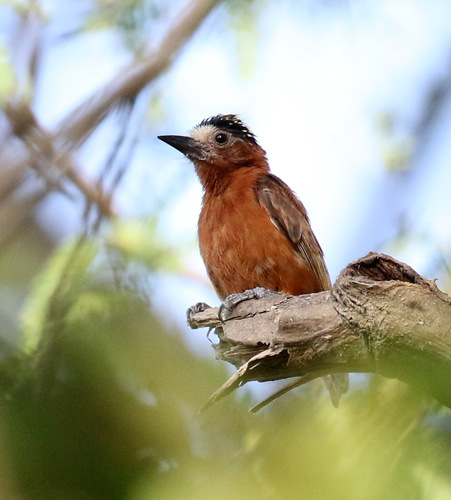
The chestnut piculet, scientific name Picumnus cinnamomeus Wagler, 1829, measures 9 to 10 cm (3.5 to 3.9 in) in length. Adult males of the nominate subspecies P. c. cinnamomeus have a pale creamy forehead, a black crown with yellow-tipped feathers, and a black nape with white-tipped feathers. The rest of the body is deep rufous to rusty brown, with the rump and belly slightly paler than other areas. The wings are dark brown, with cinnamon to rufous edges and tips on the feathers. The tail is brownish black; the innermost pair of tail feathers have a cinnamon stripe on their inner webs, and the outer two pairs have a cinnamon stripe on their outer webs. The iris is brown, the beak is blackish, the bare skin around the eye is yellow, and the legs are gray. Adult females have identical plumage except they have no yellow on the crown, and only have white spots on the hindcrown and nape. Subspecies P. c. persaturatus is a richer, darker chestnut than the nominate subspecies, has brighter wing edging, and has less defined chestnut stripes on the tail; females of this subspecies have white spots across their entire crown. P. c. perijanus is similar to P. c. persaturatus but is slightly lighter, and females have heavier crown spotting. P. c. venezuelensis is as dark as P. c. persaturatus but has a cinnamon-tawny forehead, and females have white spots only on the crown, not the nape. The subspecies of the chestnut piculet are distributed as follows: P. c. cinnamomeus is found in coastal northern Colombia, extending south into the lower Cauca River and Magdalena River valleys, and slightly east into Venezuela's Guajira Peninsula. P. c. perijanus occurs in the northern basin of northwestern Venezuela's Lake Maracaibo. P. c. persaturatus is found in Serranía de San Jerónimo, in northwestern Colombia's Bolívar Department. P. c. venezuelensis is found in Venezuela, in the southern and eastern Lake Maracaibo basin, and also extends into Venezuela's Falcón and Lara departments as the form larensis. The chestnut piculet inhabits a wide variety of landscapes, including rainforest, deciduous forest, open areas with scattered trees, arid and semi-arid scrublands, mangroves, and coffee plantations. Thorny woodlands appear to be its preferred habitat. In elevation, it ranges from sea level to 100 m (330 ft) in Venezuela, and up to 300 m (980 ft) in Colombia.