About Picumnus aurifrons Pelzeln, 1870
The bar-breasted piculet (Picumnus aurifrons Pelzeln, 1870) is the smallest living species in the diverse woodpecker family. A typical adult is about 7.5 cm (3.0 in) long and weighs 8 to 10 g (0.28 to 0.35 oz); males average 9.2 g (0.32 oz) and females average 8.6 g (0.30 oz). Standard measurements are as follows: wing chord 4.4 to 5.3 cm (1.7 to 2.1 in), tail 2.3 to 2.6 cm (0.91 to 1.02 in), beak 0.9 to 1.2 cm (0.35 to 0.47 in), and tarsus 1.1 to 1.2 cm (0.43 to 0.47 in).
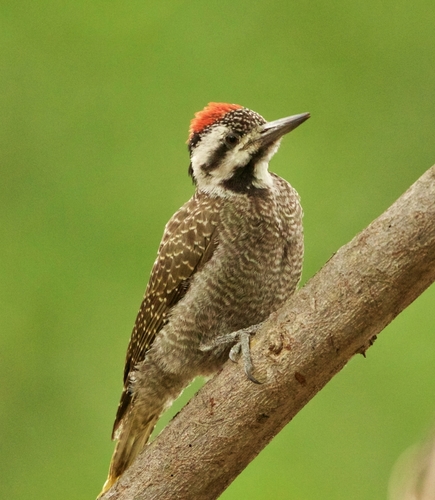
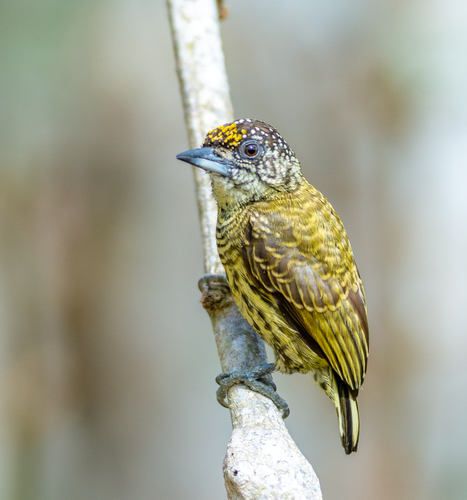
For the nominate subspecies P. a. aurifrons, adult males have a black crown with yellow streaks on the forehead and white spots on the rest of the crown, gray-brown cheeks with a whitish line behind the eye, olive green upperparts, and a black upper tail surface. The innermost pair of tail feathers have whitish yellow inner webs, and the outer two pairs have a whitish patch near the end. Their chin and throat are whitish with faint dark barring. Their underparts are yellowish white, with brown barring on the breast, arrowhead-shaped marks on the sides of the breast and upper belly, and broad brown streaks on the flanks and lower belly. Adult females are identical to males except for having white spots across their entire crown. Juveniles are similar to adults, but have a browner streaked (rather than spotted) crown and lighter streaking on the belly.
Each of the other described subspecies has distinct features: P. a. purusianus has darker upperparts than the nominate, and heavier black barring on the breast. P. a. flavifrons is similar to purusianus, but has faint barring on the upperparts, less heavy breast barring, and a heavily spotted belly. P. a. wallacii has obscure barring on its upperparts, and paler underparts with fainter streaking and more spots than P. a. purusianus and P. a. flavifrons. P. a. transfasciatus has heavy barring on its upperparts and breast. P. a. borbae has red streaks on its forehead, a yellower belly than the nominate, and stronger black barring on the breast. P. a. juruanus has reddish orange streaks on its forehead, but much weaker barring on the breast than P. a. borbae.
This species is native to the Amazon Basin, with different subspecies occupying distinct ranges. P. a. aurifrons is found in the Brazilian state of Mato Grosso, between the Madeira and Tapajós rivers. P. a. transfasciatus lives in Brazil between the Tapajós and Tocantins rivers. P. a. borbae occurs in Brazil between the Madeira and Tapajós rivers, south of the range of P. a. aurifrons. P. a. wallacii is found in Brazil between the middle and lower Purus River and the lower Madeira River. P. a. purusianus occurs along Brazil's upper Purus River. P. a. flavifrons lives in northeastern Peru and western Brazil along the Solimões (Upper Amazon) River; the South American Classification Committee of the American Ornithological Society extends this subspecies' range into southeastern Colombia. P. a. juruanus is found in eastern Peru, northern Bolivia, and western Brazil as far as the upper Juruá River.
The bar-breasted piculet primarily inhabits edges and clearings of humid tropical terra firme forest. It also occurs in várzea forest and secondary forest. Its elevation range extends from near sea level to 1,100 m (3,600 ft).