About Piculus flavigula (Boddaert, 1783)
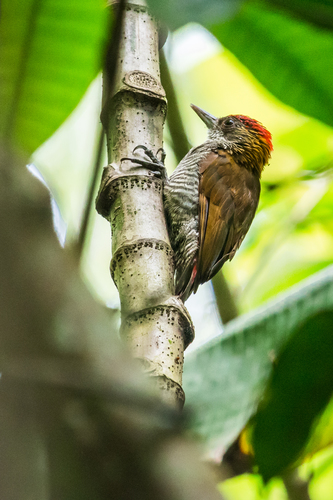
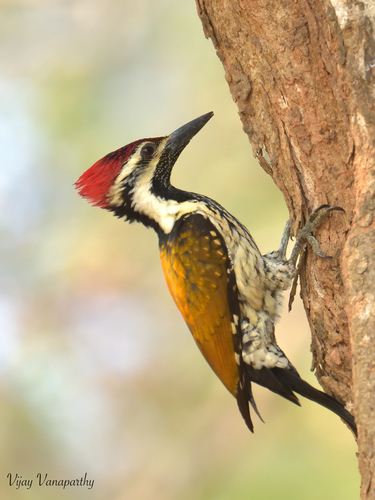
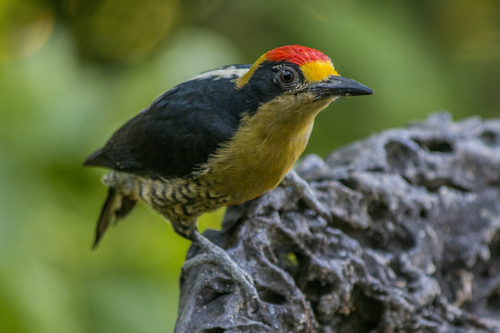
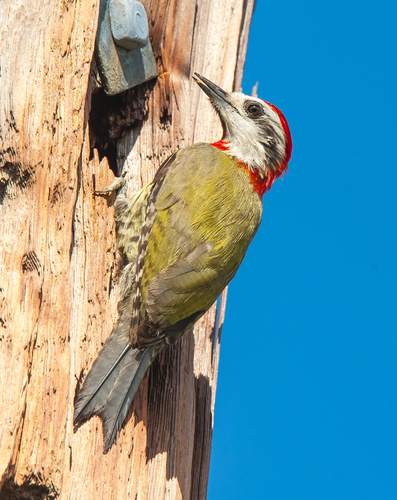
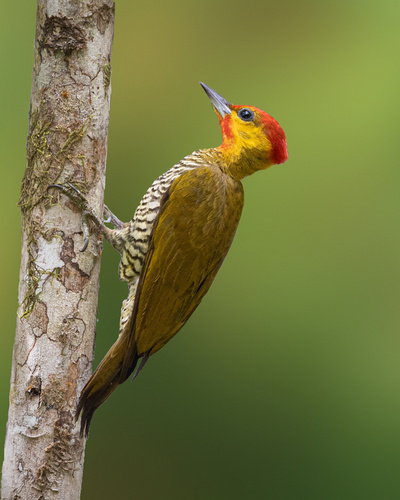
The yellow-throated woodpecker (Piculus flavigula, first described by Boddaert in 1783) measures 19 to 20 cm (7.5 to 7.9 in) in length and weighs 44 to 63 g (1.6 to 2.2 oz). Males and females share the same plumage outside of the head region. For the nominate subspecies P. f. flavigula, males have red plumage from the forehead to the hindneck, as well as on the malar (cheek) area; black feather bases are visible through the red in the forehead to hindneck region. The rest of the head, including the chin and throat, is bright golden-yellow. Females of this subspecies only have red on the nape; the rest of the crown is golden-yellow with green feather tips, and the head matches the male's pattern otherwise. Adult nominate yellow-throated woodpeckers have yellowish green upperparts that are brighter on the shoulders and back. Their flight feathers are mostly brownish black, with cinnamon patches on the inner webs. Their tail is black, with greenish edges along the feathers. Their underparts are green; breast feathers have whitish centers and black tips, while the belly and undertail coverts look barred or scaly with black markings. They have a relatively short black beak with a paler base, a brown iris, and dark green-gray legs. Juveniles have duller, greener upperparts than adults and a yellow throat, but are darker on their underparts than adults. Male juveniles may have a small red patch on the crown, while female juveniles have an entirely green crown. Subspecies P. f. magnus is identical to the nominate subspecies except that the male does not have a red malar area. Subspecies P. f. erythropis differs noticeably from the other two subspecies: it is smaller, males have more extensive red on the crown, and the red coloring of the malar region extends under the chin and throat as well. Females of this subspecies have a golden-yellow forecrown, malar area, and throat, but also have some red on the throat. For both sexes of P. f. erythropis, the underparts are more barred than spotted or scaly. The three subspecies of yellow-throated woodpecker have separate ranges: P. f. flavigula occurs in extreme eastern Colombia, extending east through southern Venezuela and the Guianas, and south into northern Brazil; P. f. magnus is found from southeastern Colombia south through eastern Ecuador and eastern Peru into northern Bolivia, and east into western Brazil; P. f. erythropis occurs separately in Pernambuco state of eastern Brazil, and between the states of Bahia and São Paulo in southeastern Brazil. The yellow-throated woodpecker lives in the interior and edges of mature terra firme and várzea forests. Subspecies P. f. erythropis is mostly found in drier caatinga habitat. This is a lowland species; its elevation ranges from sea level in the Guianas and Brazil up to 300 m (1,000 ft) in Ecuador, and up to 500 m (1,600 ft) in Peru.