About Piculus chrysochloros (Vieillot, 1818)
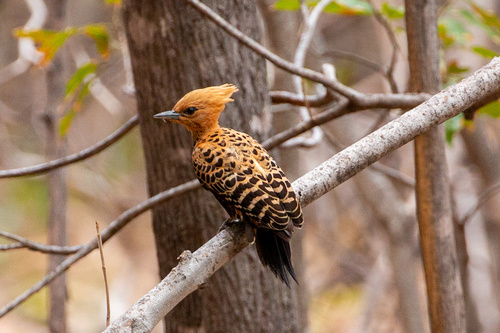
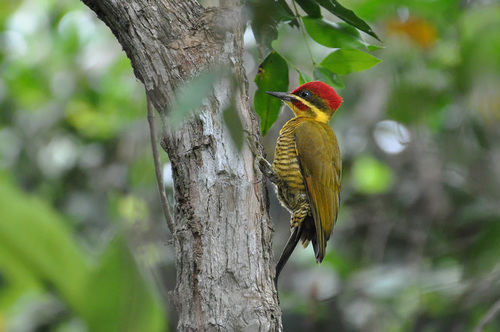
The golden-green woodpecker (Piculus chrysochloros) is 18 to 27 cm (7.1 to 11 in) long and weighs 55 to 91 g (1.9 to 3.2 oz). Males and females share the same plumage pattern except for markings on the head. For the nominate subspecies P. c. chrysochloros, males have red coloring from the forehead to the nape, with olive green coloring from the lores around the eye and extending onto the side of the neck. Below this area, there is sequentially a pale yellow stripe, a short red malar band, and an olive green stripe. Their chin and upper throat are yellow. The nominate subspecies female has no red on the head; its forehead to nape are olive, and it has an olive-brown malar area. Adult birds of the nominate subspecies have olive green upperparts. Their flight feathers and tail are darker dark olive-brown. Their underparts are pale yellow-buff marked with olive-brown bars. Their somewhat long beak is dark gray to blackish with a paler base, their iris is white to bluish white, and their legs are grayish green. Juveniles are generally duller in color than adults and have less defined barring on their underparts. Subspecies P. c. xanthochlorus is smaller and has a brighter yellow color than the nominate, and the female of this subspecies has a yellow crown. Subspecies P. c. capistratus is very large, darker olive green on the upperparts than the nominate, has less red in the malar area, a barred throat, and greenish white underparts instead of yellow buff. Subspecies P. c. paraensis is intermediate in size. Its cheek stripe, throat, and the base color of its underparts are cinnamon-buff. Males of this subspecies have a green rather than red malar, and females have a greenish yellow crown. Subspecies P. c. laemostictus is large and rather dark, with a plain whitish throat. Subspecies P. c. polyzonus is also large, with a pale yellow cheek stripe and throat, and a yellow base color on the underparts. Different subspecies of the golden-green woodpecker have distinct distributions: P. c. xanthochlorus is found in eastern Panama, northern Colombia, and northern Venezuela; P. c. capistratus ranges from southeastern Colombia south through eastern Ecuador into northern Peru, and east through the Guianas into Brazil north of the Amazon; P. c. laemostictus occurs from eastern Peru and northern Bolivia east to central Brazil south of the Amazon; P. c. paraensis is located in northeastern Brazil, with its range centered on Belém; P. c. polyzonus is found in southeastern Brazil between the states of Bahia and Rio de Janeiro; P. c. chrysochloros inhabits central and southern Brazil, eastern Bolivia, western Paraguay, and northern Argentina. The golden-green woodpecker lives in a wide variety of landscapes, most of which are at least partially wooded. These habitats include terra firme and várzea forest, rainforest, deciduous forest, and more open areas such as treed savannah, pastures, and clearings. In terms of elevation, its range goes from sea level on the Atlantic coast to 450 m (1,500 ft) in northwestern Venezuela, 650 m (2,100 ft) in southern Venezuela, 500 m (1,600 ft) in Colombia, 650 m (2,100 ft) in Peru, and up to 600 m (2,000 ft) in Ecuador (though it usually occurs no higher than 300 m (1,000 ft) there).