About Picipes badius (Pers.) Zmitr. & Kovalenko
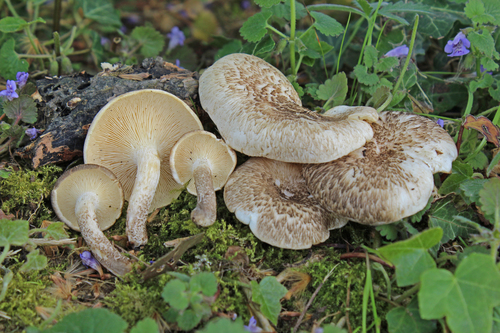
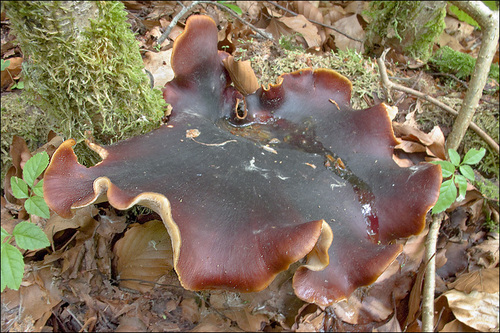
The fruit bodies of Picipes badius are typically upright, and grow either alone or in groups; sometimes two or more fruit bodies develop from a shared stipe. The cap is either circular or kidney-shaped, and often has lobes or a wavy edge. Young fruit bodies have a convex cap shape, which becomes flat or funnel-shaped as it reaches maturity. Mature caps measure 4–25 cm (1+1⁄2–10 in) across and 1–4 mm (0.04–0.16 in) thick. The upper surface of the cap is smooth and glossy, and develops radial wrinkles as it ages. Cap color is brown, usually darker at the center and lighter at the margins, and may turn black with age. The undersurface of the cap is white or cream-colored, and yellows as it ages. The pores are round, with 4–8 pores per millimeter, and the shallow pore tubes attach from adnate to decurrent along the stipe. The stipe attaches to the cap either centrally or laterally; it is 1–8 cm (1⁄2–3+1⁄4 in) long and 0.3–1.5 cm (0–1⁄2 in) thick, with a velvety texture and dark brown to blackish-brown color, turning black and developing longitudinal wrinkles when old. The fruit bodies are inedible due to their tough texture. The spores are ellipsoid or cylindrical, smooth, translucent (hyaline), and measure 7.5–9 by 3–5 μm. The spore-bearing basidia are club-shaped with a narrow base, and measure 20–30 by 7–9 μm. Like other species that were formerly placed in the genus Polyporus, Picipes badius has a dimitic hyphal structure, meaning its hyphae consist of both generative hyphae and skeleto-ligative hyphae, which makes its mushroom tissue hard and woody. There are no cystidia in the hymenium. When grown in pure culture, this fungus produces asexual spores. Picipes badius is a saprobic fungus that causes white rot. It grows on standing or fallen trunks and branches of many hardwood genera, including Acer, Aesculus, Alnus, Betula, Castanea, Fagus, Fraxinus, Populus, Prunus, Robinia, Quercus, Salix, Tilia and Ulmus. It occurs in temperate regions of Asia, Europe, and North America.