About Picea jezoensis (Siebold & Zucc.) Carrière
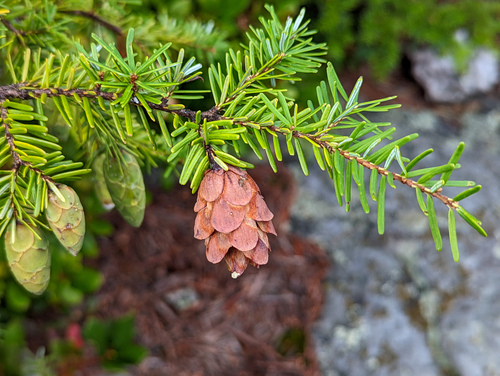
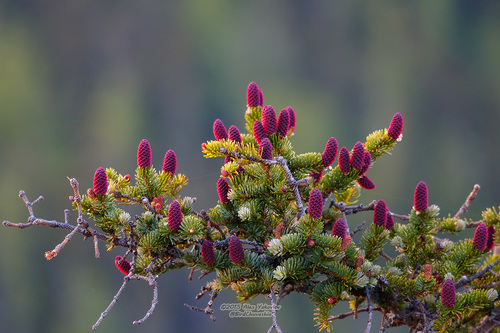
Picea jezoensis (Siebold & Zucc.) Carrière, sometimes misspelled as Picea yezoensis, is commonly known as dark-bark spruce, Ezo spruce, Yezo spruce, or Jezo spruce. It is a large evergreen tree that grows 30 to 50 meters tall, with a trunk diameter reaching up to 2 meters. This species is native to northeast Asia, occurring from the mountains of central Japan and the Changbai Mountains on the China-North Korea border, northward to eastern Siberia including the Sikhote-Alin range, Kuril Islands, Sakhalin and Kamchatka. It grows in cold, humid temperate rain forests, and its entire range stays within 400 kilometers of the Pacific Ocean. The specific epithet jezoensis comes from Ezo, an old name for Hokkaido and other islands north of the Japanese island of Honshu, where the species occurs. Its bark is thin and scaly, and develops fissures in old trees. The crown has a broad conical shape. Shoots are pale buff-brown, hairless, and have prominent pulvini. The leaves are needle-like, 15 to 20 millimeters long and 2 millimeters broad, flattened in cross-section. They are dark green on the upper surface with no stomata, and blue-white to white on the lower surface with two dense bands of stomata. The cones are pendulous and slender cylindrical. They measure 4 to 7 centimeters long and 2 centimeters broad when closed, and open to 3 centimeters broad. They have thin, flexible scales 12 to 18 millimeters long. The cones are green or reddish when young, and mature to pale brown 5 to 6 months after pollination. The seeds are black, 3 millimeters long, with a slender, pale brown wing 6 to 8 millimeters long. There are two recognized geographical subspecies; some authors treat these two taxa as varieties, while others treat them as separate species. Picea jezoensis subsp. jezoensis (Ezo spruce) occurs across most of the species' full range, south to Hokkaidō, Japan. Its shoots are very pale buff-brown, almost white; its stomatal bands are blue-white; its cones are pale brown with flexible scales. Picea jezoensis subsp. hondoensis (Mayr) P. A. Schmidt (Hondo spruce) is an isolated southern population found on high mountains in central Honshū, Japan. Its shoots are buff-brown to orange-brown, only rarely very pale; its stomatal bands are bright white; its cones are orange-brown with stiffer scales. Jezo spruce is very closely related to Sitka spruce (Picea sitchensis), which replaces it on the opposite side of the North Pacific. P. jezoensis, particularly P. jezoensis subsp. jezoensis, can be difficult to distinguish from Sitka spruce; the clearest distinguishing feature of P. jezoensis is the absence of stomata on the upper surface of its leaves. Its leaves are also somewhat blunter, with less sharply spine-tipped tips, than the leaves of Sitka spruce.