About Picea abies (L.) H.Karst.
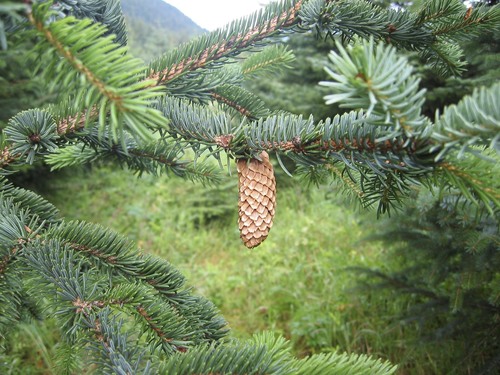
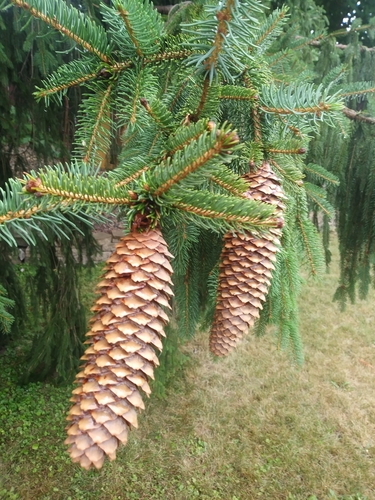
Picea abies (L.) H.Karst., commonly called Norway spruce, is a large, fast-growing evergreen coniferous tree. It typically reaches 35–55 m (115–180 ft) in height, with a trunk diameter between 1 and 1.5 m. Growth is particularly rapid when the tree is young: under good conditions, it can grow up to 1 m per year for the first 25 years, but growth slows once it exceeds 20 m (65 ft) tall. Its shoots are orange-brown and hairless (glabrous). The leaves are needle-like with blunt tips, 12–14 mm long, quadrangular in cross-section, and dark green on all four sides with faint, hard-to-see stomatal lines. Seed cones are 9–17 cm long – the longest of any spruce – with scale tips ranging from bluntly to sharply triangular-pointed. Cones are green or reddish when young, and mature to brown 5–7 months after pollination. The seeds are black, 4–5 mm long, with a 15 mm pale brown wing. The tallest recorded Norway spruce is 62.26 m (204.3 ft) tall, growing near Ribnica na Pohorju, Slovenia.
Its native range extends across Europe, from Norway in the northwest and Poland eastward. It also grows in the mountains of central Europe, reaching southwest to the western end of the Alps, and southeast through the Carpathians and Balkans to the extreme north of Greece. Its northern limit lies in the Arctic, just north of 70° N in Norway. The eastern limit in Russia is difficult to define, because of extensive hybridization and intergradation with the Siberian spruce, and is usually placed at the Ural Mountains. However, trees with some Siberian spruce characteristics grow as far west as most of northern Finland, with a few records from northeast Norway. This hybrid is called Picea × fennica (or P. abies subsp. fennica, if the two parent taxa are considered subspecies), and can be identified by its tendency to have hairy shoots and cones with smoothly rounded scales. In its ecology, caterpillars of the tortrix moth Cydia illutana feed on Norway spruce cone scales, while Cydia duplicana feeds on bark around injuries or canker on the tree.
Norway spruce is one of the most widely planted spruces, both within and outside its native range, and is one of the most economically important conifer species in Europe. It is grown as an ornamental tree in parks and gardens, and is widely planted for use as a Christmas tree. Every year, Oslo, the capital of Norway, gifts a Norway spruce to the cities of London (for the Trafalgar Square Christmas tree), Edinburgh, and Washington, D.C., where it is displayed in each city's central square. This gift is given primarily as gratitude for the aid these countries provided to Norway during the Second World War. In North America, Norway spruce is widely planted, specifically in the Northeastern, Pacific Coast, and Rocky Mountain United States, as well as in southeastern Canada. It has become naturalised in some parts of North America, with established naturalised populations found from Connecticut to Michigan, and likely in other locations as well. Norway spruce prefers areas with cool summers, and will grow up to USDA Growing Zone 7, except along the west coast of North America, where summers are cool enough for it to grow even in parts of USDA Growing Zone 10 (Sunset Climate Zones 14-17). Seed production begins when the tree is in its fourth decade of life, and total lifespan can reach up to 300 years within its native European range. Introduced Norway spruces in the British Isles and North America have a much shorter average lifespan. As the tree ages, its crown becomes less dense and lower branches die off. In the northern United States and Canada, Norway spruce is reported to be invasive in some locations, but it does not cause problems in Zone 6 and further north, because seed germination rates drop significantly in areas with hot, humid summers. Norway spruce tolerates acidic soils well, but does not grow well on dry or nutrient-poor deficient soils. From 1928 until the 1960s, it was planted on surface mine spoils in Indiana.
In forestry, Norway spruce is used for softwood timber and paper production. Norwegian company Borregaard produces a synthetic substitute for natural vanilla, called vanillin, using Norway spruce. The company is currently the only producer of wood-based vanillin, and states that customers prefer it in part because it has a much lower carbon footprint than vanillin synthesized from petrochemicals. It is highly valued as a source of tonewood by stringed instrument makers, and is commonly used to make violins. A form of the tree called Haselfichte (Hazel-spruce) grows in the European Alps and has been recognized by UNESCO as intangible cultural heritage; this form was used by Stradivarius to make instruments.
As a food and medicinal resource, Norway spruce is the source of spruce beer, which was once used to prevent and even cure scurvy. In traditional Austrian medicine, Norway spruce shoot tips have been used internally (as syrup or tea) and externally (in baths, for inhalation, as ointments, as a resin application, or as tea) to treat disorders of the respiratory tract, skin, locomotor system, and gastrointestinal tract, as well as infections. During production of Mont d'Or cheese, the cheese is wrapped in a band called a "sangle" made from the cambium of Norway spruce (known in French as Épicéa commun) for at least around two weeks, which gives the cheese its unique flavor. In Finland, Norway spruce tips (called kuusenkerkkä in Finnish) are used as a spice in products including syrup, herbal tea, alcohol, smoothies, salt, and desserts. Spruce tip syrup is also used as a cold medicine.