About Pica pica (Linnaeus, 1758)
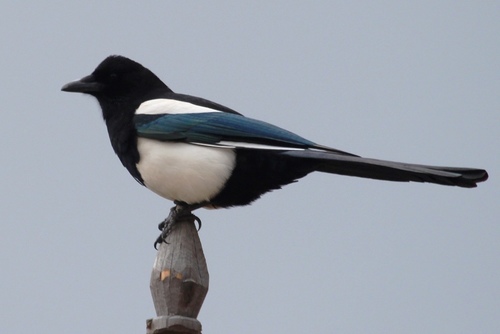
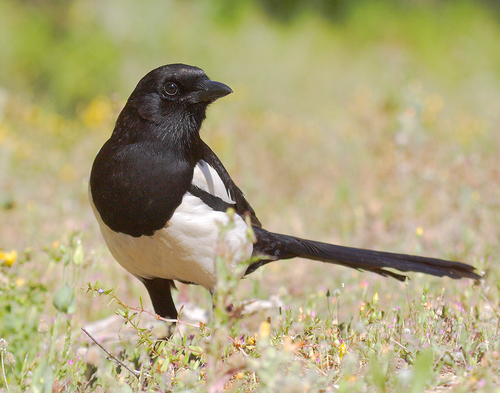
The adult male of the Eurasian magpie (Pica pica) nominate subspecies, P. p. pica, is 44–46 cm (17–18 in) in total length, with the tail making up more than half of this length. Its wingspan measures 52–62 cm (20–24 in). The head, neck, breast and vent are glossy black with a metallic green and violet sheen; the belly and scapulars (shoulder feathers) are pure white. The wings are black with green or purple gloss, and the primaries have white inner webs that are conspicuous when the wing is open. The graduated tail is black, glossed with green and reddish purple. Legs and bill are black, and the iris is dark brown. The rump is black, with a white stripe above it that varies in thickness between different subspecies. Male and female plumage is similar, though females are slightly smaller. Tail feathers of both sexes are quite long, measuring around 12–28 cm. Nominate subspecies males weigh 210–272 g (7.4–9.6 oz), while females weigh 182–214 g (6.4–7.5 oz). Juvenile Eurasian magpies resemble adults, but their sooty plumage initially lacks the adult gloss. Juveniles have a pink malar region and somewhat clear eyes, and their tail is much shorter than an adult's tail. Different subspecies vary in overall size, the amount of white in their plumage, and the color of the gloss on their black feathers. The Asian subspecies P. p. bactriana has more extensive white markings on its primary feathers and a prominent white rump. Adult Eurasian magpies undergo a complete annual moult after breeding. This moult process begins in June or July and finishes in September or October, with primary flight feathers replaced over a three-month period. Juvenile birds go through a partial moult that starts about one month after adult moulting begins; during this partial moult, only body feathers are replaced, while wing and tail feathers remain unchanged. The Eurasian magpie has a distinctive call. It produces either a choking chatter "chac-chac" or a repetitive "chac-chac-chac-chac". Juveniles use these calls too, and also make an acute "Uik Uik" call that resembles the barking of a small dog. Both adult and young magpies can also produce a faint hiss that is barely noticeable from a distance. The Eurasian magpie's range extends across temperate Eurasia, from Portugal, Spain and Ireland in the west to the Kamchatka Peninsula in the east. Eurasian magpies prefer open countryside with scattered trees, and are normally absent from treeless areas and dense forests. They sometimes breed at high densities in suburban areas such as parks and gardens, and can often be found close to city centres. In Sweden, magpies are exclusively associated with human settlements, and it is extremely rare to find a magpie more than a few hundred metres from a human dwelling. Archaeological finds have suggested that magpies began acting as scavengers around human communities as early as the Scandinavian Bronze Age, and certainly by the Scandinavian Iron Age. Eurasian magpies are usually sedentary, and tend to stay close to their nesting territories through winter. However, populations living near the northernmost limits of the species' range, in Sweden, Finland, and Russia, may move south during harsh weather conditions.