About Piaya minuta (Vieillot, 1817)
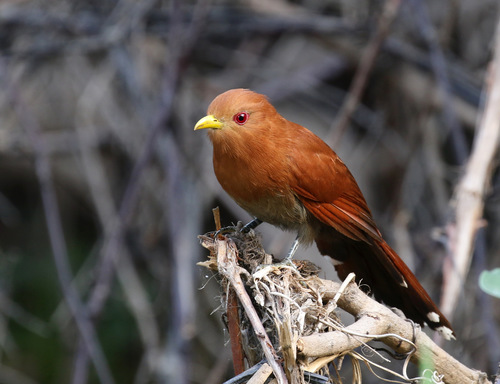
This species, the little cuckoo, has the scientific name Piaya minuta (Vieillot, 1817). Adults reach around 27 centimetres (11 inches) in length and weigh approximately 40 grams (1.4 ounces). Adult plumage is primarily chestnut brown, with a greyish lower belly, a browner tail, and white tips on the tail feathers. Its bill is yellow, short, and curved downward, and it has a red iris. Immature little cuckoos are dark brown with black bills and lack white tail tips. It is smaller and has a darker throat than the squirrel cuckoo. The little cuckoo produces harsh chek and kak calls. This small cuckoo's range extends from Panama and Trinidad, south through Colombia to Bolivia, Peru, and Brazil. In Ecuador, individuals have been recorded at elevations up to 1,900 metres (6,200 feet) above sea level. It inhabits mangrove swamps and scrubby woodland located near water. It is generally thought to be a year-round resident, but its irregular appearance in some regions has led to speculation that it makes seasonal short-distance migrations. It has a fairly wide distribution and is not especially rare, so the IUCN does not classify it as a threatened species. The little cuckoo is a shy bird that stays within dense cover while foraging for insects and other arthropods on low branches. The female lays two white eggs in a deep cup nest built in a tree or bamboo. Like most American cuckoos, this species incubates its own eggs.