About Piaya melanogaster (Vieillot, 1817)
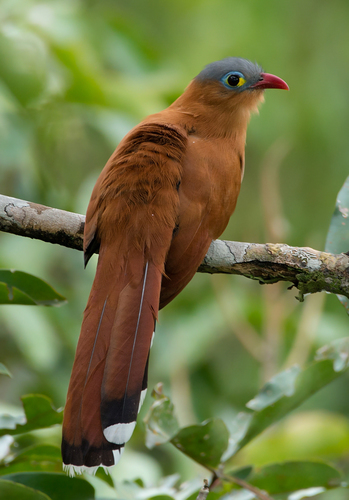
Adult Piaya melanogaster have an average length between 38 and 40.5 cm. They have an intense purple-red beak, dark red irises, blue orbital skin, and one yellow spot on the anterior side of each eye. Their heads are grey, contrasting with their ruffled backs. Throats and chests are a reddish-brown, cinnamon color, while bellies and undertail coverts are black. Tails are black with conspicuous white stripes. Juveniles look similar to adults. P. melanogaster occurs within the same range as the similar related species, the squirrel cuckoo (Piaya cayana). Black-bellied cuckoos can be distinguished by their dark faces and grey crowns. Squirrel cuckoos have exposed yellow-greenish orbital skin, grey chest plumage, and lack the black-bellied cuckoo's characteristic hood. P. melanogaster is a low density species with an Amazonian distribution. It can be found in the upper levels of tropical rainforests, and occasionally in savanna forests. It prefers habitats at altitudes up to 800 meters above sea level. It is native to southern and eastern Guyana, Surinam, French Guiana, eastern Venezuela, Northern Bolivia, Colombia, Ecuador, eastern Peru, and Brazil, and is a permanent resident throughout its range. In Guyana, the black-bellied cuckoo occurs in Kanashen. In Bolivia, it is found in the department of La Paz. In Colombia, it occurs in southern Meta department, northwest Guainía department, and southern Vaupés department. In Ecuador, it is found below 400 meters above sea level, and is infrequently seen in the eastern lowlands. In Brazil, this cuckoo occurs in the Alta Floresta region north of Mato Grosso, in southeastern Amazonia. Black-bellied cuckoos inhabit tropical rainforests, scrub, and occasionally wooded savannas. Unlike squirrel cuckoos, they do not often use open areas, and they remain in the upper levels of forests. It is estimated that deforestation reduces suitable habitat within the species' range by about 10% every three generations, which is approximately 13 years. Little is known about the reproductive cycle of P. melanogaster. There are records of reproductively active individuals during April in Upper Orinoco, Venezuela. In French Guiana, nestlings have been observed being fed from July to November. This species builds its nests in trees, and lays up to 2 pure white eggs. The average lifespan of P. melanogaster is 4.2 years.