About Piaya cayana (Linnaeus, 1766)
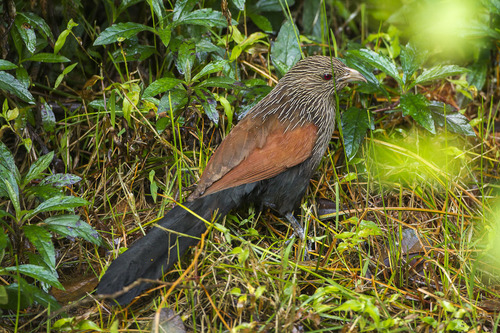
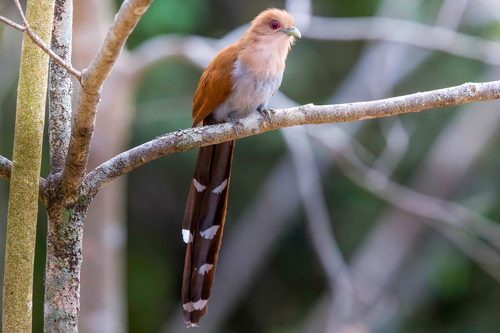
Piaya cayana, commonly known as the squirrel cuckoo, is a large cuckoo with an extremely long tail. Adults measure 40.5–50 cm (15.9–19.7 in) in length and weigh 95–120 g (3.4–4.2 oz). Adult plumage is primarily chestnut on the upperparts and head, fading to a paler shade on the throat, with grey lower breast and blackish belly. The central tail feathers are rufous, while the outer tail feathers are black with white tips. Adults have a yellow bill and red iris. Immature birds have a grey bill, grey eyering, brown iris, and less white on the tail. This species is similar in appearance to the little cuckoo, but the little cuckoo is smaller and has a darker throat. Multiple subspecies of Piaya cayana exist, with minor differences in plumage. For example, P. c. mehleri, a South American subspecies, has mostly brown outer tail feathers instead of black. Subspecies from Mexico, Central America, and northern and western South America have a yellow eye-ring, while subspecies from the rest of South America have a red eye-ring. The squirrel cuckoo produces explosive "kip!" and "kip! weeuu" calls, and its song is a series of whistled "wheep wheep wheep wheep" notes. The squirrel cuckoo inhabits woodland canopies and edges, second growth, hedges, and semi-open habitats, ranging from sea level up to 2,500 m (8,200 ft), though it is uncommon above 1,200 m (3,900 ft). Its English common name comes from its habit of running along branches and leaping between branches like a squirrel. It usually only flies short distances, mostly gliding with occasional wing flaps. It feeds on large insects including cicadas, wasps, and caterpillars (even those with stinging hairs or spines), and occasionally eats spiders, small amphibians, and small reptiles such as small lizards; it rarely consumes fruit. Non-flying prey is typically captured from foliage with a quick lunge, while wasps may be caught in mid-air. During the dry season, squirrel cuckoos are often observed foraging peacefully alongside small mammals such as common marmosets (Callithrix jacchus) near cocoa beans. They frequently join other foragers at army ant columns, where they capture prey flushed out by the ants, and they will occasionally join mixed-species feeding flocks. The squirrel cuckoo builds a cup-shaped nest made of leaves on a twig foundation, hidden in dense vegetation 1–12 m (3.3–39.4 ft) high in a tree. Females lay two white eggs. The squirrel cuckoo is abundant across most of its range and is quite tolerant of human disturbance as long as woodland habitat remains. Unlike many cuckoo species, it is relatively bold and conspicuous, though it is most often found moving secretively within vegetation. Due to its large geographic range, the IUCN classifies the squirrel cuckoo as a species of Least Concern.