About Piaractus brachypomus (Cuvier, 1818)
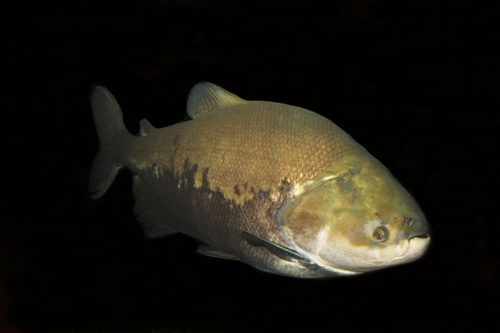
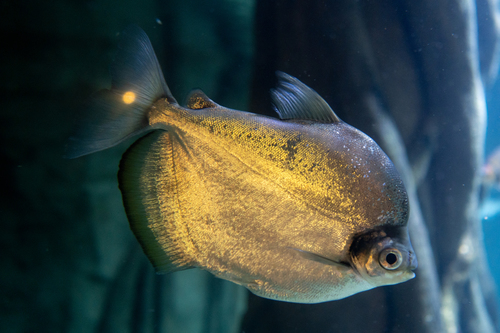
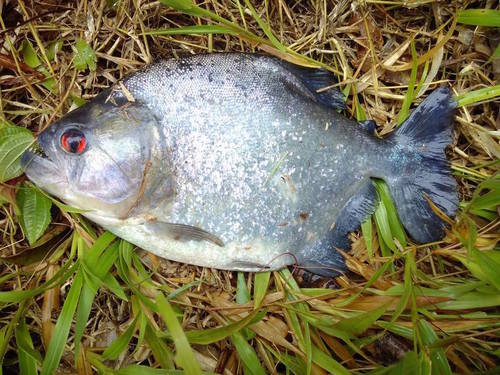
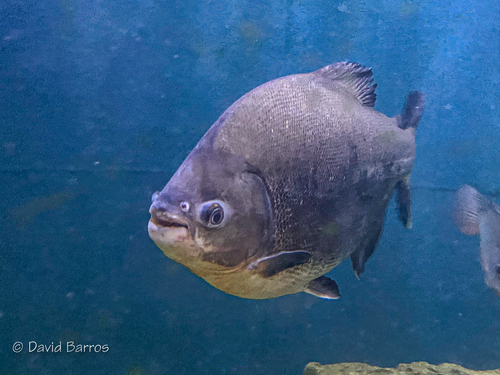
Piaractus brachypomus, commonly called the red-bellied pacu, can reach a maximum length of 88 cm (2.9 ft) and a maximum weight of 25 kg (55 lb). Juveniles have a distinct red chest and stomach, which makes them easily confused with the carnivorous red-bellied piranha (Pygocentrus nattereri). The two species can be distinguished by their teeth: Piaractus brachypomus has molar-like teeth. This similarity in appearance is thought to be Batesian mimicry, used by P. brachypomus to avoid predation by other species. Adult Piaractus brachypomus do not have the bright red chest and belly that juveniles have, and they resemble the tambaqui (Colossoma macropomum). They can be told apart from tambaqui by several meristic and morphological features: the red-bellied pacu has a smaller adipose fin that lacks rays, there are differences in its teeth and operculum, and it has a more rounded head profile that is less elongated and pointed than the tambaqui’s. Piaractus brachypomus can also be distinguished from the only other member of its genus, P. mesopotamicus, by its larger scales and lower number of lateral scales (fewer than 110). In general, the behavior of Piaractus brachypomus resembles that of its close relative the tambaqui. It is a migratory species, but its specific migration pattern is not well understood. Spawning takes place at the start of the flood season, which falls between November and February. Red-bellied pacu larvae are found in whitewater rivers, while adults primarily live in flooded forests and floodplains across various river types, including both nutrient-rich and nutrient-poor rivers. Unlike the tambaqui, the red-bellied pacu lives in the headwaters of nutrient-poor rivers, not just their lower sections. The red-bellied pacu feeds mainly on fruits, seeds, and nuts, but it is an opportunistic feeder. It will also eat zooplankton, insects, crustaceans, and small fish, especially during the dry season. Overall, more seeds pass undamaged through the red-bellied pacu’s digestive system than through the tambaqui’s, which means the red-bellied pacu is a more efficient seed disperser overall.