About Phytotoma rutila Vieillot, 1818
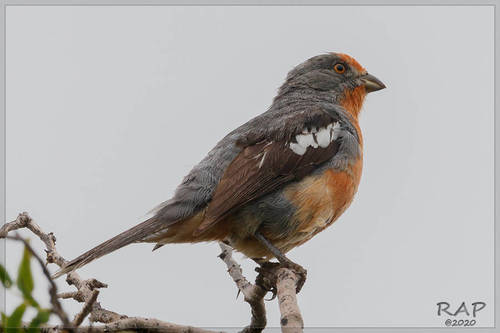
White-tipped plantcutter, scientifically named Phytotoma ruta Vieillot, 1818, measures 18 to 19.5 cm (7.1 to 7.7 in) in length and weighs 30 to 57 g (1.1 to 2.0 oz). Males and females of this species have different plumage. Adult males of the nominate subspecies have a rufous forehead, dark gray crown and cheeks, and a short crest; the gray plumage has sparse darker streaks. Their upperparts are also dark gray with sparse darker streaks. Their wings are dusky blackish, with white tips on the coverts that form two visible wing bars. Their tail is dusky blackish, with wide white tips on all feathers except the central pair. Their chin, throat, and most underparts are rufous, with gray-brown sides and flanks. Adult females have mostly blackish brown heads and upperparts. Their heads have white streaks, and their backs have buffish gray streaks. Their wings are mostly blackish brown; the wing coverts have thin white tips that form wing bars, and their tertials have pale edges. Their tail is blackish brown, with white edges on the outer webs of the outer feathers. Their throat and underparts are buffy to ochraceous, marked with thick blackish brown streaks. Males of the subspecies P. r. angustirostris have wider white tail tips, and both sexes have a thicker bill than the nominate subspecies, but are otherwise identical to the nominate. For both subspecies, both sexes have a pale yellowish to hazel iris, a stout conical dark gray to blackish bill, and dark gray legs and feet. Small serrations line the cutting edges of the bill. Of the two subspecies, P. r. angustirostris is distributed further north. It occurs in central and southern Bolivia, extending into Salta Province of northern Argentina. The nominate subspecies ranges from Paraguay south into western Uruguay, and into northern and eastern Argentina as far south as northeastern Chubut Province. The species has also been recorded as a vagrant in Brazil and Chile. It lives in a variety of mostly fairly open landscapes, including open woodlands, lowland and montane scrublands, riparian thickets, portions of the Pampas, and gardens and orchards. East of the Andes, its elevation range extends from sea level to 1,800 m (5,900 ft), while within the Andes it occurs between 600 and 3,600 m (2,000 and 11,800 ft).