About Phytotoma rara Molina, 1782
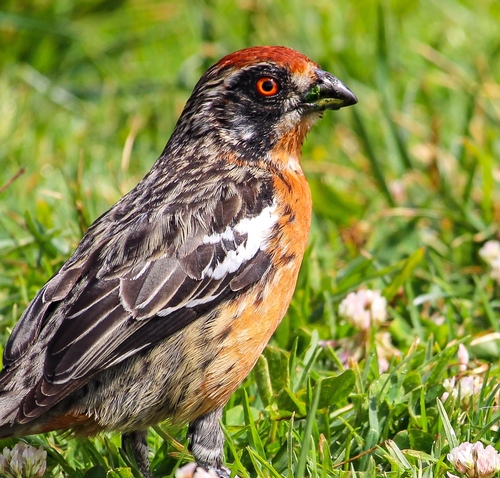
This species, commonly known as the rufous-tailed plantcutter, is a stocky bird measuring 18 to 20 centimetres in length, with short wings and a red eye. Its longish tail is black with a reddish base. Males have grey-brown upperparts marked with dark streaks, while their crown and underparts are chestnut-colored. Males also have a white bar on the wing, and a pattern of dark and pale areas on the face. Females have buff underparts with brown streaks, and have buff instead of white in the wing. Females lack the male's chestnut crown, but may have a cinnamon wash over the forehead and throat. The song consists of a series of stuttering notes followed by a rasping trill, which resembles the noise made by a fishing reel. Its short, thick finch-like bill has serrated edges, and is used to strip off buds, leaves and fruits. It occasionally eats insects, which are also fed to its chicks. This cotinga is found further south than any other member of its family, and inhabits scrub, forest edges and river valleys in Chile and western Argentina. In Chile, its range extends from the Magallanes region north to Atacama; in Argentina, it extends from Santa Cruz north to Mendoza. Birds that breed in southern or high-altitude regions migrate northwards or toward lowlands during winter. It has been recorded as a vagrant to the Falkland Islands. These birds are often seen in gardens, farmland and orchards, and are sometimes considered a pest. It builds a cup-shaped nest from root fibres and twigs, placed in a fork of a shrub or tree. It lays two to four blue-green eggs, with dark spots concentrated at the larger end.