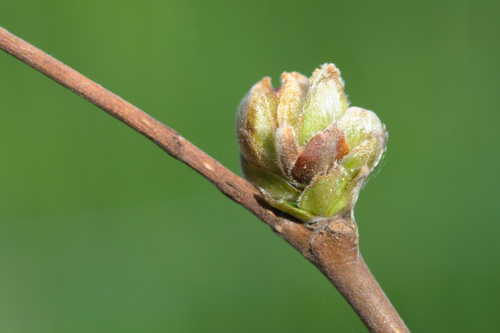
About Phytoptus avellanae Nalepa, 1889
Phytoptus avellanae Nalepa, 1889 is an acarine gall-mite species that induces big bud galls up to 10 millimetres (0.39 in) across, which are sometimes slightly open, on the buds of hazel (Corylus avellana) and filbert (Corylus maxima). Its known synonyms are Phytocoptella avellanae, Eriophyes avellanae, Calycophthora avellanae, Phytoptus coryli, Phytoptus pseudogallarum, and Acarus pseudogallarum. The mites are white, roughly 0.3 mm long, and have numerous tergites and sternites. Two distinct forms of P. avellanae exist: one that causes galls, and a vagrant form that has a more complex life cycle and does not form galls. This species has different common names across regions: in Germany it is called Haselnussgallmilbe and Haselnuss-Knospengallmilbe, in Spain it is called Badoc del avellano, in France it is called Phytopte du noisetier, in Italy it is called Eriofide del nocciolo, in the United Kingdom it is called Filbert bud mite and Hazelnut gall mite, and in Turkey it is called Fındık kozalak akarı. In its life cycle, early autumn sees gall-mites leave their now reddish-brown host bud and migrate to a young bud, or more commonly a newly formed male catkin. They remain inactive between the flower scales here until late winter, when the catkins begin to elongate. At this late winter stage, the mites feed on sap, which causes the scales to swell and open, distorts the stamens, and eventually makes the stamens disappear. Female mites leave the buds or catkins in April to find new buds or female flowers to invade and lay eggs inside. The nymphs develop and mature into adults between June and July, before invading the new buds that grow on the current year's shoots.

