About Phytomyza ilicis Curtis, 1846
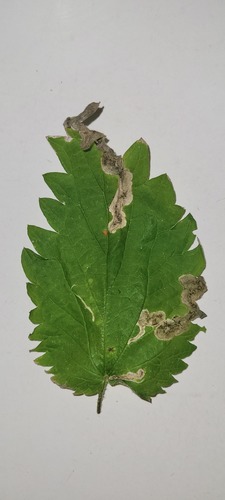
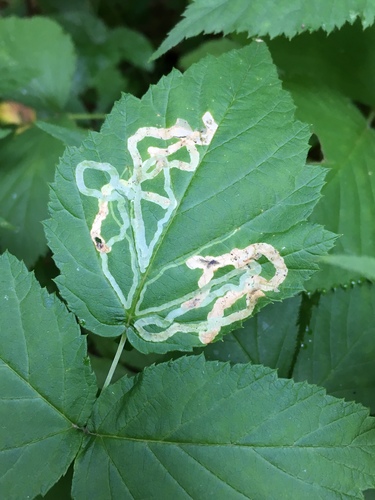
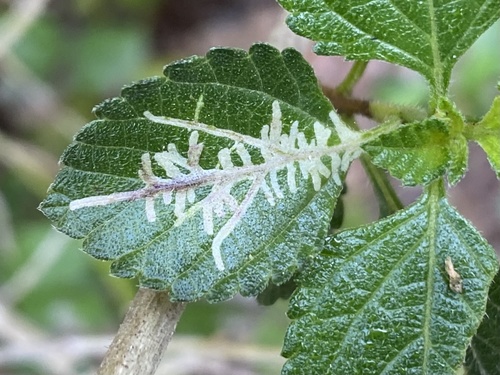
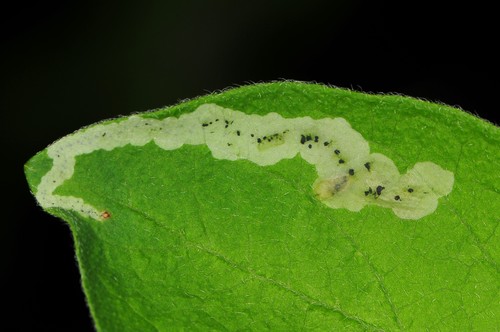
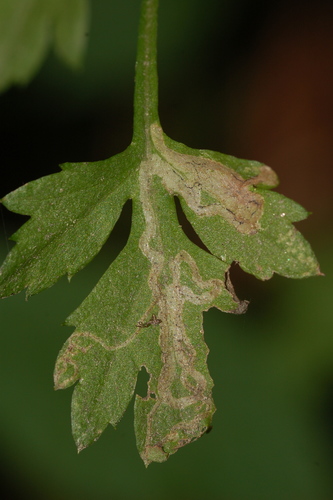
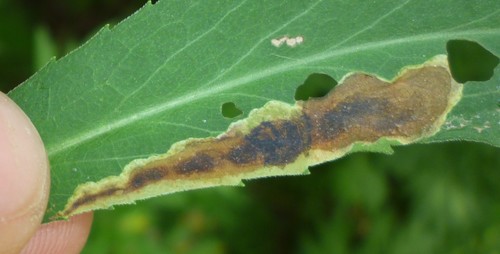
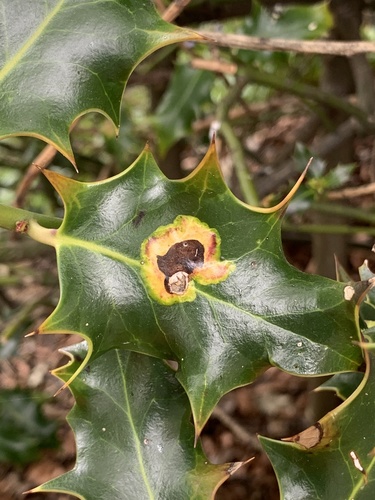
Adults of Phytomyza ilicis are small, with a wing length of 2.5–3 millimetres (0.098–0.118 in). They have red eyes and 6–8 pairs of acrostichal bristles on the thorax. Like most fly larvae, P. ilicis larvae are pale, legless maggots that lack a head capsule as well as thoracic and abdominal legs. The dark brown puparium forms from the hardened final larval skin. This species, commonly called the holly leaf miner, is found across the Holarctic region on its host plant Ilex aquifolium. It is common and widespread in Europe, and has been introduced to western Canada and the northwestern United States. Its distribution likely depends on average temperatures; Peterkin and Lloyd found it is absent from areas where the mean temperature of the coldest months of the year falls below −0.5 °C (31.1 °F). Female Agromyzidae insert eggs into leaf tissue using an ovipositor. For P. ilicis, this is difficult because its host plant has unusually tough leaves. Oviposition is only possible during the annual new leaf flush in April and May, when new leaves unfold. P. ilicis lays eggs on the underside of the leaf petiole, or on the basal part of the leaf midrib. Oviposition creates a distinctive characteristic scar, which can be used to estimate how many eggs were deposited. A 1978 study found a maximum of five eggs laid per leaf, with no more than two of these eggs reaching the larval stage. The same study recorded an average of 38.6 eggs per 100 leaves on a single plant, and found that only 9.85% of these eggs survive to produce viable, healthy larvae after accounting for natural mortality, and parasite and predatory factors. After hatching, the larva tunnels along the midrib toward the leaf tip. It only enters the leaf blade around January, where it begins creating a visible, recognizable leaf mine. In one study that compared P. ilicis to P. ilicicola on Ilex plants, P. ilicis had an average of 0.23 mines per leaf (equal to one mine for every four to five leaves on a plant). Up to three mines can occur on a single leaf – this number is often far lower than the number of oviposition scars on the leaf, indicating that intra-leaf competition between larvae has occurred. P. ilicis is univoltine, producing one generation per year. Adults emerge in late May to June, and leave an emergence hole larger than 1 mm; exit holes made by parasitoids of this species are much smaller.