About Phytolacca americana L.
Phytolacca americana L., commonly called pokeweed, belongs to the family Phytolaccaceae. It is a large herbaceous perennial plant that can grow up to 2.5 metres (8 feet) tall over one growing season, and can reach 3 metres (10 feet) in maximum height though most mature plants grow between 1.2 and 2 metres (4 to 6 and a half feet) tall. Plants need a few years of growth before their root is large enough to support this full size. One to several branches grow from the crown of a thick, white, fleshy taproot; botanist Michael D. K. Owen describes the branches as "stout, smooth, [and] green to somewhat purplish". Early in the growing season, pokeweed produces an upright central stem; by late season, the stem shifts to a spreading, horizontal form under the weight of the plant's berries. The stem turns red late in the season, has a chambered pith, and the entire above-ground portion of the plant dies back to the roots each winter.
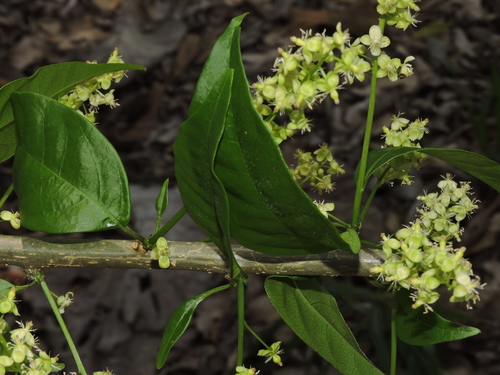
Leaves are simple, entire, alternately arranged along the stem, and have long petioles. They have a coarse texture with moderate porosity, can grow up to 41 centimetres (16 inches) long, and are medium green and smooth, with a distinct odor that many people find unpleasant.
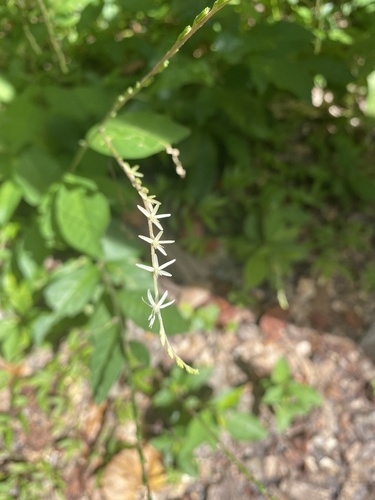
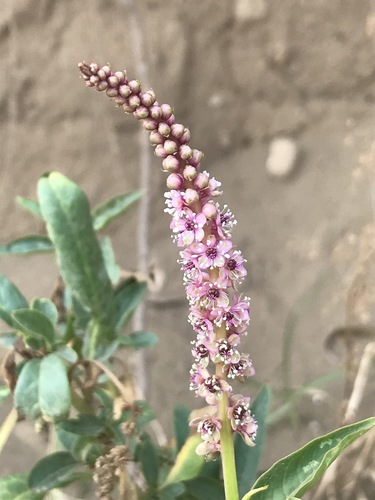
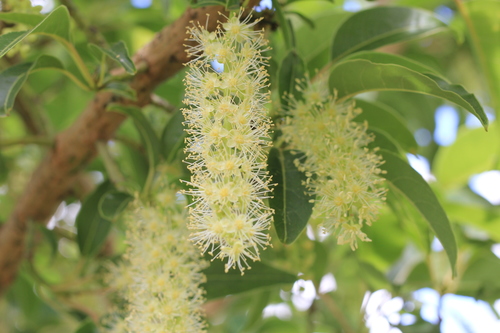
Pokeweed produces perfect, radially symmetric flowers, which grow in elongated clusters called racemes. Each flower has 4–5 white or green petal-like sepals and no true petals, with 5 regular parts, upright stamens, and reaches up to 5 millimetres (1/4 inch) wide. Flowers grow on white pedicels and peduncles that darken as fruits develop. Blooming begins in early summer and continues into early fall.
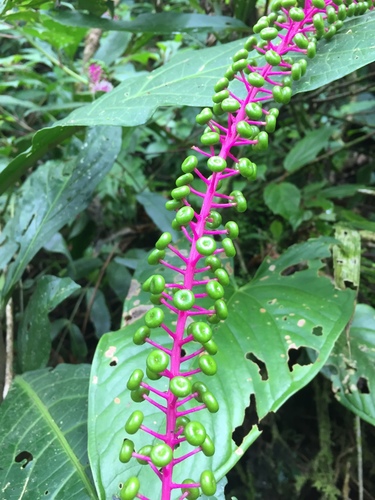
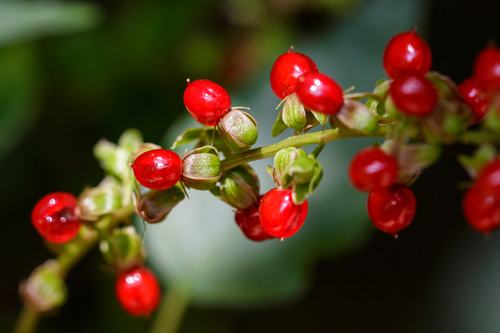
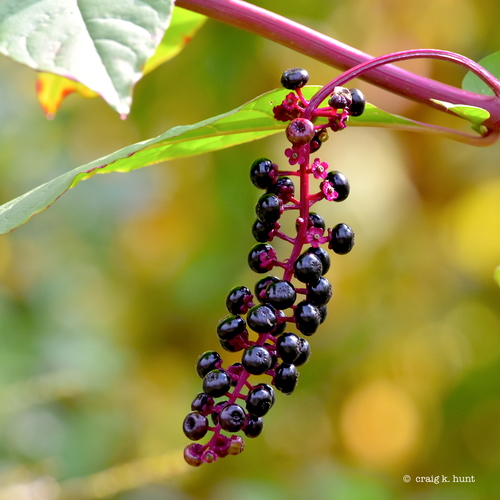
After flowering, pokeweed produces fleshy, 10-celled berries that range in color from purple to near-black, and contain crimson juice. Berries form in racemose clusters held on pink pedicels with a pink peduncle, are round with a flat indented top and bottom. Immature berries are green, then turn white, before ripening to blackish purple. Pedicels that do not develop berries have a distinctive rounded five-part calyx. Each berry contains large, glossy black, lens-shaped seeds. Pokeweed reproduces only by seed, and seeds have long viability, able to germinate after many years buried in soil.
The root is a thick central taproot that grows deep and spreads horizontally, growing rapidly. It has a tan outer cortex, white inner pulp, a moderate number of small rootlets, and transversely cut root slices show visible concentric rings. The species has no ability to fix nitrogen.
Pokeweed is native to eastern North America, the Midwest, the Gulf Coast, and the West Coast of the United States. It is an introduced weed in Japan.
Birds are unaffected by the toxins in pokeweed berries, eat the berries, and disperse the seeds. The berries are a documented good food source for songbirds and other bird species, plus small animals that tolerate the toxins. Dispersal by birds explains why isolated pokeweed plants often appear in areas that otherwise have no established pokeweed populations. Documented songbird species that feed on the berries include the gray catbird (Dumetella carolinensis), northern mockingbird (Mimus polyglottos), northern cardinal (Cardinalis cardinals), brown thrasher (Toxostoma rufum), mourning dove (Zenaida macroura), and cedar waxwing (Bombycilla cedrorum). Small mammals that tolerate pokeweed toxins include raccoon, opossum, red and gray fox, and the white-footed mouse. Black bears sometimes feed on pokeweed. The larvae of some Lepidoptera species, including the giant leopard moth (Hypercompe scribonia), also use pokeweed as a food source.
All parts of the pokeweed plant are toxic and pose health risks to humans and other mammals. Toxin concentration is highest in the rootstock, followed by leaves and stems, then ripe fruit. Toxicity generally increases as the plant matures; the exception is berries, which are dangerous even when unripe and green. Children may be attracted to pokeweed's berry clusters. The Ohio Agricultural Research and Development Center (OARDC) notes that children are poisoned most often by eating raw berries. Infants are especially sensitive, and have died after eating only a few raw berries. Adults have been poisoned, sometimes fatally, after eating improperly prepared leaves and shoots (especially when root material is accidentally harvested with the shoot), and after mistaking the taproot for an edible tuber. Research in humans has shown that common pokeweed can cause mutations (which may lead to cancer) and birth defects. Pokeweed juice can be absorbed through the skin, so contact between plant parts and bare skin should be avoided. The plant should be completely avoided during pregnancy, and children who consume even one berry may require emergency medical treatment. Plant sap can cause dermatitis in people with sensitive skin. Most animals dislike the taste of pokeweed and avoid it, unless it is the only available food source or it becomes mixed into their feed. Livestock have been poisoned after eating fresh green leaves or roots. When poisoning is fatal, death usually occurs due to respiratory paralysis. Pokeweed poisoning was common in eastern North America during the 19th century, most often from using pokeweed tinctures as antirheumatic treatments, and from eating berries or roots that were mistaken for parsnip, Jerusalem artichoke, or horseradish.
According to Owen, pokeweed acts as a slow-acting but violent emetic when ingested internally. Vomiting usually begins around two hours after plant material is eaten. Severe poisoning cases cause purging, spasms, and sometimes convulsions, with fatal cases most often resulting from paralysis of the respiratory organs. Any case of human or animal poisoning should be treated by a physician or veterinarian. OARDC scientists add that common poisoning symptoms include a burning sensation in the mouth, salivation, gastrointestinal cramps, vomiting, and bloody diarrhea. Depending on the amount consumed, more severe symptoms can develop, including anemia, altered heart rate and respiration, convulsions, and death from respiratory failure. People and animals usually recover within one to two days after ingesting only small quantities of the plant.
Owen notes that Indigenous peoples and early European settlers used pokeweed root in poultices and specific preparations to treat skin diseases and rheumatism. King's American Dispensatory, a late 19th century herbal text, documents a wide range of folk medical uses that led people to ingest pokeberry products. In the 1890s, Phytolacca extract was advertised as a prescription weight loss drug. Today, pokeweed is promoted in alternative medicine as a dietary supplement claimed to treat a wide range of conditions including mumps, arthritis, and various skin conditions. While pokeweed has been studied in laboratory settings, there is no medical evidence that it provides any beneficial health effects for humans.
Poke, prepared from young pokeweed leaves and stems, is a traditional food in southern Appalachia. Young plant parts can be eaten only after proper preparation: they must be boiled two or more times, with the water drained and replaced between each boil. Prepared leaves have a flavor similar to spinach, while stems taste similar to asparagus. A 1917 article on edible wild weeds noted that pokeweed shoots were popular in Pennsylvania, where they were tied in small bundles, boiled like asparagus, and served with cream sauce or melted butter. The roots, as well as mature leaves and stems, are poisonous. Some festivals still celebrate the plant's historical use as food. As recently as the 1990s, two companies commercially canned and sold pokeweed, but the last of these, the Allen Canning Company of Siloam Springs, Arkansas, closed its pokeweed canning operation in 2000.
Other uses of pokeweed include ongoing exploration of its plant toxins as a method to control zebra mussels. A pink dye can be processed from the toxic extract of ripe pokeweed berries, and early European settlers to North America obtained a fine red dye from the plant's roots. In the mid-19th century, wine was often colored with pokeberry juice. Phytolacca contains lectins called Pokeweed mitogen, which are used to stimulate B-cell proliferation. This property makes them useful for B-cell assays, immunodeficiency diagnostic tests, and immunotherapy.