About Physocarpus opulifolius (L.) Maxim.
Physocarpus opulifolius (L.) Maxim. is a mound-shaped deciduous shrub with arching stems that bear alternate, simple leaves. It reaches a height of 1–3 m (3–10 ft) and has a spread of 1–2 m (4–6 ft). Individual leaves range from 3–12 cm (1–5 in) long and feature palmately veined lobes.
This species is fast-growing, resistant to insects and disease, and drought-tolerant. It adapts to an extremely wide range of soil and site conditions, tolerating environments from moist to dry, acid to alkaline, and gravelly to heavy clay; it can grow in conditions from partial shade to full sun.
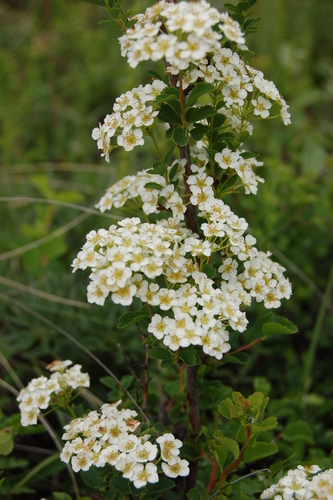
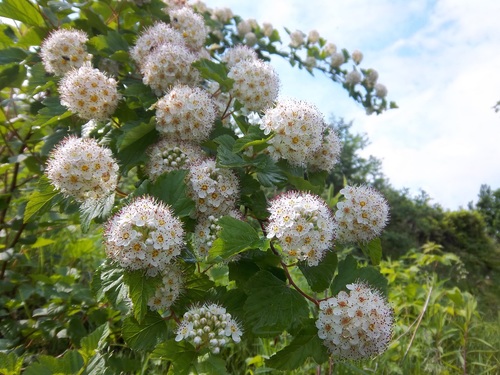
Its 5-petaled flowers are 6–8 mm (0.24–0.31 in) in diameter and arranged in corymbs. Flower color ranges from white to pinkish, and blooming occurs from May to June in North America. In Missouri, the fruits ripen from August to early October; these fruits are small, dry pods that hang in drooping, papery clusters. The bark of the shrub peels off in thin papery strips shaped like the number nine, exposing brown inner bark — this feature is the origin of its common name.
In distribution and habitat, Physocarpus opulifolius is native to eastern North America, where it grows on rocky hillsides, stream banks, and in moist thickets, particularly in counties south of the Missouri River. A scarcely distinguishable form of the species also occurs in the Rocky Mountain region and the Pacific Northwest. Its native range extends from New York west to Minnesota and South Dakota, and south to Florida, Arkansas, and Kansas. It can also be found growing from Quebec west to Minnesota, South Dakota, and Colorado, south to Oklahoma and Georgia, and north to New York, where it occurs as an escape, meaning it is a formerly cultivated plant that has become established wild, northeast of its native range.
Ecologically, this species acts as a larval host for the dimorphic eulithis, Macaria abruptata, the white spring moth, Ancylis spiraeifoliana, and the blinded sphinx moth. It may also act as a host for the bluish spring moth. Larvae of the raspberry leafroller have also been recorded feeding on this plant.
In terms of uses, Physocarpus opulifolius's ability to grow in harsh conditions makes it especially well-suited for erosion control on banks. It is also widely grown as an ornamental plant for its foliage. Numerous cultivars have been developed, three of which — 'Dart's Gold', 'Diabolo', and 'Tuilad' — have gained the Royal Horticultural Society's Award of Garden Merit. Newer cultivars provide varied foliage color as well as a smaller overall mature plant size.