About Physocarpus capitatus (Pursh) Kuntze
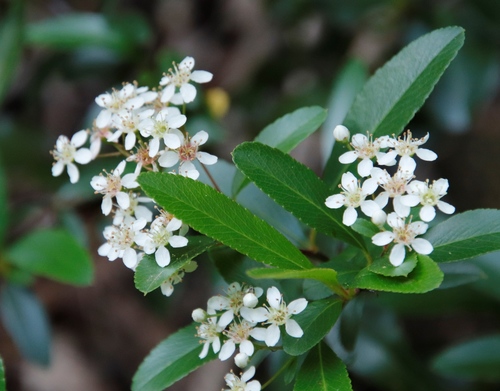
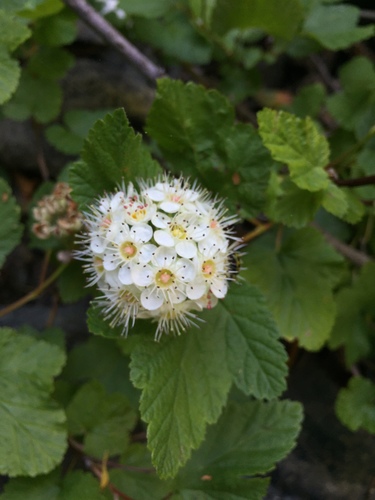
Physocarpus capitatus (Pursh) Kuntze, commonly called Pacific ninebark, is a dense deciduous shrub that reaches 1 to 2.5 metres (3+1⁄2 to 8 feet) in height. It has flaky reddish-gray bark that peels away in many irregular thin layers. Its leaves are distinctively grape or maple-shaped, palmately lobed, and measure 3 to 14 centimetres (1 to 5+1⁄2 inches) in both length and width. The leaves have deep veins and double-toothed margins, with a dark, shiny green upper surface. It produces clusters of small, creamy white flowers that each have five petals and numerous red-tipped stamens; flowers emerge in late spring and last into midsummer. Its unique fruit is an inflated glossy red pod around 6 millimetres (1⁄4 inch) long. When the fruit dries, it turns brown and splits open to release seeds. This species occurs at low and middle elevations from southern Alaska, east to Montana and Utah, and south to southern California. It is most common west of the Cascades and Sierra Nevada, and is often abundant on the north slopes of coastal mountains. It is less prevalent in the eastern portion of its range, where its distribution overlaps with mallow ninebark. It is often found in wetlands, and also forms thickets along rivers and in moist forest habitats. While it grows most vigorously in wet environments, it has some degree of drought tolerance. It prefers partial shade, but tolerates full sun, and adapts to many different soil types. Though it has low palatability for browsing ungulates, Pacific ninebark provides high-quality cover and nesting sites for birds and small mammals. Birds eat its seeds, which remain in the seed heads through winter. Some sources consider this plant toxic. Indigenous groups used Pacific ninebark as an emetic and a laxative. Its stems were used to make children's hunting bows and small items such as needles, while straighter shoots were used to make arrows. Bark from this plant was mixed with cedar bark to make a dark brown dye. It is used in ecological restoration because its fibrous roots are effective for bank stabilization, and it can grow from cuttings. Additionally, it does not require an overhead canopy to become established at restoration sites, as it tolerates direct sun. It can grow aggressively enough to shade out invasive species including reed canary grass and Himalayan blackberry. It is a popular garden plant in California.