About Physignathus cocincinus Cuvier, 1829
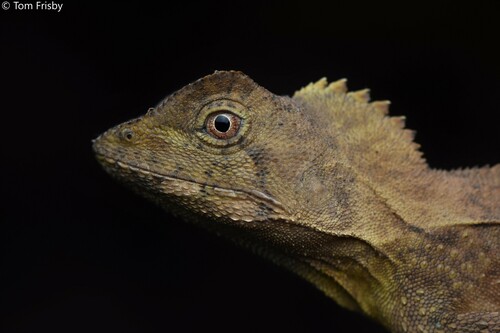
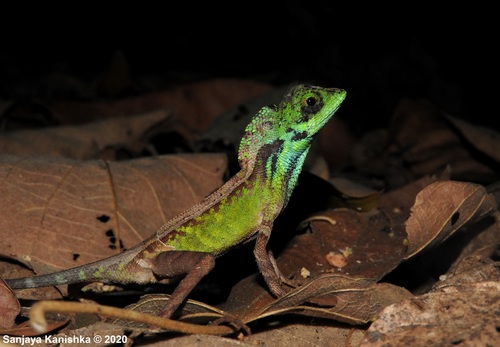
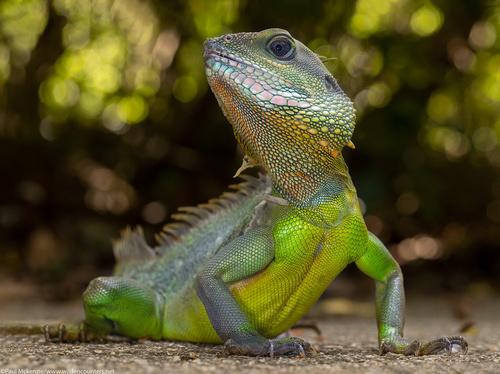
Description: Adult Chinese water dragons (Physignathus cocincinus) are large, robust lizards. Males can reach a total length (including the tail) of up to 90 cm (3.0 ft). The tail is very long, making up more than 70% of the lizard’s total body length. Maximum snout-vent length (excluding the tail) is around 25 cm (9.8 in) for males and 20 cm (7.9 in) for females. The body and tail are compressed, meaning they are taller than they are wide, while the limbs are long and muscular, each ending in five sharp claws. In both sexes, a fringe of enlarged scales runs the full length of the spine. The tympanum (eardrum) is partially exposed, with its rim covered by scales. A row of 8 or 9 large white plate-like scales sits on the edge of the lower jaw, below the infralabials (the lower lip scale row). Chinese water dragons have distinct sexual dimorphism: males are heavier, reaching up to 0.6 kg (1.3 lbs), and have prominent display features. An arched crest extends from the rear of the neck onto the back, and a second low crest is present at the base of the tail. Males have a larger, more triangular head, with swollen jowls that bear pale tubercles (prominent pointed scales). Unlike anoles and iguanas, Chinese water dragons have no dewlap. Males have a functional series of femoral pores on the underside of the thigh, while in females these pores are only subtle indentations. Females reach a maximum weight of 0.25 kg (0.55 lb), and have a smaller head and lower crests. Their base coloration is usually a shade of bright green, though they can turn brown or grey when stressed. Juveniles have vibrant green or turquoise diagonal stripes on their bodies, which may fade as they mature. Most of the tail is marked with thick alternating bands of light green and dark brown. Some individuals have a dark stripe running between the eye and ear. Most of the undersides are pale, but the throat is a more colorful yellow or orange, especially in adult males. Scales on the cheek and lower jaw may develop blue or pink coloration in adults. Native range: Chinese water dragons are native to subtropical forests of southern China (Guangdong, Guangxi, and Yunnan provinces) and Southeast Asia (Vietnam, Laos, parts of Cambodia, eastern Thailand). There are also unconfirmed reports of the species from Myanmar. Habitat: Chinese water dragons are most often found in dense closed evergreen forest along the banks of freshwater streams. They live in a humid climate with mild seasons: average humidity between 40–80% and temperatures ranging from 27–32 °C (80–90 °F). Their reliance on undisturbed forest streams means that despite their wide extent of occurrence in Southeast Asia, Chinese water dragons are a geographically restricted species. They occur at elevations from around 50 to 820 meters (160 to 2,690 feet), but their density and abundance drop sharply above approximately 270 meters (890 feet). Despite their preference for undisturbed habitat, Chinese water dragons are common in Hong Kong’s urban parks. Even so, they systematically prefer areas with streamside boulders, taller trees, and a denser canopy. While all observed individuals have streams within their territory, less than half of first-hand records place them within 5 meters of a stream. Males prefer to defend wide or deep streams, while female territories include more dry land. The lizards frequent rocks and concrete structures for basking. They avoid orchards, as orchards provide neither the protection of dense forests nor the heat retention of concrete. Habitat loss: Degradation or removal of the forested stream habitats Chinese water dragons depend on is a smaller but still impactful threat. In Thua Thien Hue, Vietnam, illegal logging and a major highway construction project are likely partially responsible for population losses in the Nam Dong and A Luoi districts. These pressures are less common in the uplands of Phong Dien district, which has not experienced the same level of population decline. Logging and expansion of agricultural and tourism infrastructure also contribute to the lack of suitable habitat in Northern Vietnam. Coal mining, stream pollution, and climate change may also threaten the species, as has been reported for ecologically similar regional reptiles such as the Chinese crocodile lizard (Shinisaurus crocodilurus). Despite its common name, the Chinese water dragon is extremely rare in China, where it faces additional threats from dam construction alongside the same pressures affecting Vietnamese populations. Suitably undeveloped habitats are uncommon in Cambodia and Laos. The small Chinese water dragon population in Thailand is stable and locally abundant because its range overlaps with protected areas including Khao Yai National Park and Namtok Phlio National Park. Behavior and ecology: Chinese water dragons are diurnal (active during the day) and forage for prey within small territories in the morning and midday. They are also semi-arboreal, spending much of their time in trees or plants. Adult males in particular typically rest at night on tree limbs overlooking streams. When threatened, a Chinese water dragon will leap or run to the nearest stream, then either swim to safety or remain submerged for up to 90 minutes. In Hong Kong, the average territory size is around 1800 m2, with a small average daily range of about 5 meters. Male territories generally do not overlap with each other, indicating that males are far more territorial than females. Unlike most other subtropical reptiles, Chinese water dragon movement and range patterns are similar between the hot wet summer and the relatively cool dry winter. This may be an unintended result of the unusually warm and wet dry season that occurred during the 2015–2016 study interval in Hong Kong. Captive male Chinese water dragons are very aggressive toward each other, while females and juveniles are more tolerant. Reproduction and life history: Chinese water dragons are oviparous. Females lay a clutch of 5 to 16 eggs, which are buried in sandy riverbanks near the end of the dry winter. The eggs hatch two to three months later, at the start of the wet summer. Individuals reach maturity within their first year, and the average generation length is about 6 years. Captive females may breed multiple times per year. Healthy captive Chinese water dragons have a life expectancy of 10 to 15 years, though some individuals live longer than 20 years. While wild Chinese water dragons reproduce sexually, there is one recorded case of facultative parthenogenesis in a captive individual. A female housed at the Smithsonian National Zoo produced viable offspring in 2016 and 2018, alongside numerous unfertilized nonviable eggs. The two surviving offspring were homozygous or hemizygous at seven specific microsatellite loci in their genome. This outcome would be nearly impossible with sexual reproduction, as at least a few of the seven loci would be expected to be heterozygous. Physignathus cocincinus is the only agamid lizard known to reproduce via parthenogenesis, though the low hatch rate suggests this is an accidental occurrence rather than an established evolutionary strategy.