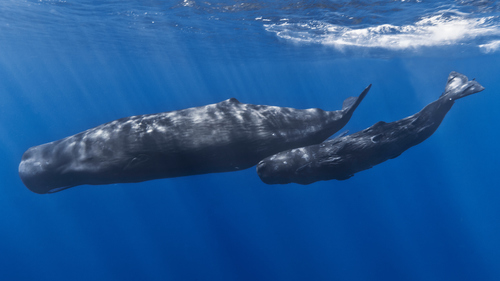
About Physeter macrocephalus Linnaeus, 1758
The sperm whale or cachalot (Physeter macrocephalus) is the largest toothed whale and the largest toothed predator. It is the only living member of the genus Physeter, and one of three existing species in the sperm whale superfamily Physeteroidea, alongside the pygmy sperm whale and dwarf sperm whale of the genus Kogia. The sperm whale is a pelagic mammal with a worldwide range, and migrates seasonally for feeding and breeding. Females and young males live together in groups, while mature males (called bulls) live solitary lives outside of the mating season. Females cooperate to protect and nurse their young. Females give birth every four to twenty years, and care for their calves for more than a decade. A mature, healthy sperm whale has no natural predators, though calves and weakened adults are sometimes killed by orca pods. Mature males average 16 metres (52 ft) in length, with the head making up to one-third of the animal’s total length. Sperm whales can plunge to 2,250 metres (7,380 ft), making them the third deepest diving mammal, outranked only by the southern elephant seal and Cuvier's beaked whale. The sperm whale uses echolocation and vocalization with an underwater source level as loud as 236 decibels (re 1 μPa m), the loudest sound produced by any animal. It has the largest brain on Earth, more than five times heavier than a human’s. Sperm whales can live 70 years or longer. Sperm whales’ heads are filled with a waxy substance called "spermaceti" (also called sperm oil), which gives the species its common name. Spermaceti was a primary target of the whaling industry, and was used in oil lamps, lubricants, and candles. Ambergris, a solid waxy waste product sometimes found in its digestive system, is still highly valued as a fixative for perfumes, among other uses. Beachcombers search for ambergris that washes up as flotsam. Sperm whaling was a major industry in the 19th century, famously depicted in the novel Moby-Dick. The species is protected by the International Whaling Commission moratorium, and is listed as vulnerable by the International Union for Conservation of Nature. Sperm whales are among the most cosmopolitan species. They prefer ice-free waters deeper than 1,000 metres (3,300 ft). While both sexes range through temperate and tropical oceans and seas, only adult males live at higher latitudes. In several regions, such as the coastal waters of southern Australia, sperm whales are considered locally extinct. They are relatively abundant from the poles to the equator, and found in all the world’s oceans. They inhabit the Mediterranean Sea, but not the Black Sea, while their presence in the Red Sea is unconfirmed. The shallow entrances to both the Black Sea and the Red Sea may explain their absence from these bodies of water. The Black Sea’s lower layers are also anoxic and contain high concentrations of sulfur compounds such as hydrogen sulfide. The first ever recorded sighting off the coast of Pakistan was made in 2017. The first ever record off the west coast of the Korean Peninsula (Yellow Sea) was made in 2005, followed by another near Ganghwa Island in 2009. Population densities are higher close to continental shelves and canyons. Sperm whales are usually found in deep, offshore waters, but may be seen closer to shore in areas where the continental shelf is narrow and drops quickly to depths of 310 to 920 metres (1,020 to 3,020 ft). Coastal areas with large sperm whale populations include the Azores and Dominica. In east Asian waters, sperm whales are also regularly observed in coastal waters at locations including the Commander and Kuril Islands, Shiretoko Peninsula (one of the few places where sperm whales can be observed from shore), off Kinkasan, near Tokyo Bay and the Bōsō Peninsula to the Izu and Izu Islands, the Volcano Islands, Yakushima and the Tokara Islands to the Ryukyu Islands, Taiwan, and the Northern Mariana Islands. Historical catch records suggest there could have been smaller aggregation grounds in the Sea of Japan as well. Along the Korean Peninsula, the first confirmed observation within the Sea of Japan (eight animals off Guryongpo) was made in 2004, after the last catches of five whales off Ulsan in 1911. In April 2025, a 10-year-old adult male, 15–20 meters (49–66 ft) long and weighing over 30 tonnes (33 short tons), was sighted at the Port of Gwangyang. Nine whales were observed on the East China Sea side of the peninsula in 1999. Mature males are known to enter surprisingly shallow bays to rest, and whales remain in a resting state during these visits. Unique coastal groups have been reported from various areas around the globe, including near Scotland’s coastal waters, the Shiretoko Peninsula, off Kaikōura, and in Davao Gulf. These coastal groups were more common before the era of widespread whaling. Genetic analysis indicates that the global sperm whale population originated in the Pacific Ocean from a population of approximately 10,000 animals around 100,000 years ago, when expanding ice caps blocked their access to other seas. In particular, research shows that the Atlantic was colonized multiple times during this range expansion. Sperm whales can live 70 years or more; the oldest recorded living sperm whale was 77–80 years old. They are a prime example of a K-selected species, meaning their reproductive strategy is tied to stable environmental conditions, and includes a low birth rate, significant parental care for offspring, slow maturation, and long lifespan. How sperm whales choose mates has not been definitively determined. Bulls fight with each other over females, and males mate with multiple females, making the species polygynous, but males do not dominate groups in a harem structure. Bulls do not provide paternal care to their offspring, but do display a fatherly role to younger bulls to demonstrate dominance. Recent studies show that associations between male and female groups are temporary, and associations between groups and individual males are determined by female choice rather than male aggression. Supporting this finding, aggression between male sperm whales is rare within breeding grounds. Only one case of male-male aggression was recorded over 11 years in a 40-year study around the Galapagos Islands, and no aggression was reported in a similar 20-year study off the Dominican Republic. Males do occasionally have teeth marks, which may have formed during intra-sex competition, but this raises the possibility that teeth marks on male sperm whales evolved as a signal of male dominance rather than a direct result of competition for females. However, observations of fights may be rare because fights between males happen very quickly or occur underwater. Females generally reach sexual maturity between 6–13 years of age, with an average age of sexual maturity around 9 years, and become fertile around age 10. The age of sexual maturity in females varies considerably across regions. Female sperm whales’ reproductive capacity declines steadily from age 10–14, then drops sharply after age 40. The oldest pregnant female ever recorded was 41 years old. Gestation lasts 14 to 16 months, and results in a single calf. Sexually mature females give birth once every 4 to 20 years; pregnancy rates were higher during the whaling era. Birth is a social event, as the mother and calf need other group members to protect them from predators. Other adults may jostle and bite the newborn in its first hours of life. Females reach their full size between 25–45 years of age. Lactation lasts 19 to 42 months, though very rarely calves may suckle for up to 13 years. Like other whales, sperm whale milk has a higher fat content than the milk of terrestrial mammals: approximately 36% fat, compared to 4% in cow milk. This gives the milk a consistency similar to cottage cheese, which stops it from dissolving in water before the calf can drink it. It has an energy content of roughly 3,840 kcal/kg, compared to only 640 kcal/kg in cow milk. Calves may be allowed to suckle from females other than their own mother. Males become sexually mature between 9–21 years of age. Upon reaching sexual maturity, males move to higher latitudes, where the water is colder and feeding is more productive. Females stay at lower latitudes. Males reach their full size between 50–60 years of age.

