About Physciella chloantha (Ach.) Essl.
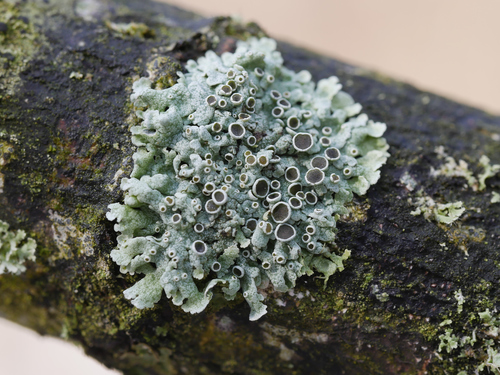
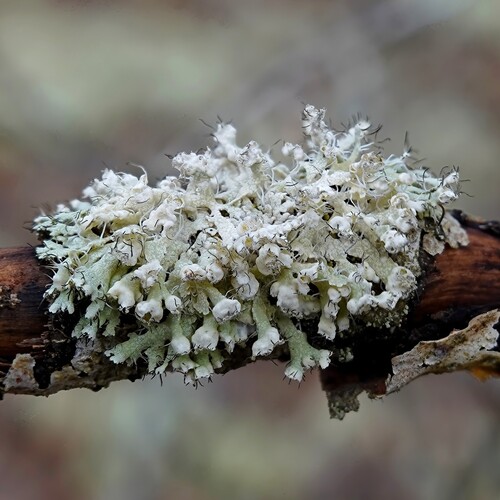
Physciella chloantha (Ach.) Essl. typically forms rounded growth units up to about 3 cm (1.2 in) in diameter, made up of many separate ascending lobes. These lobes, which measure 0.5–1.5 mm across, can grow together to cover large areas, often blending in with other lichen species. Lobes range from short and rounded to somewhat elongated, and frequently curve upward at the tip, especially when they produce soredia. The thallus of this lichen is defined by numerous marginal and terminal, lip-shaped (labriform) soralia; scattered laminal soralia may also sometimes develop over time. The lower surface of the lichen is white to pale tan, with sparse rhizines that match the lower surface in color. The placement of these rhizines varies widely between different specimens. Fruiting bodies called apothecia are rare in this species; they grow up to 1 mm in diameter, and may be either sessile or on very short stalks, with a smooth or irregularly scalloped (crenate) margin. The spores match the Physcia-type, measuring 17–22.5 by 8–11 μm, with cell lumina that often become rounded as the spores age. Conidia are ellipsoid, measuring 2.5–3.5 by 1 μm. Physciella chloantha is often confused with its close relative Physciella melanchra, which differs mainly by having mostly laminal soralia and an average larger size. Specimens of Physciella chloantha with well-developed laminal soralia require careful differentiation from Physciella melanchra, especially as the two sometimes grow together in the same habitats. Once overlooked in North America, Physciella chloantha is quite common in some parts of its range. It was previously mapped in North America under the synonym Physcia luganensis. This species has also been recorded in southern and south-central Europe, as well as Japan. It grows primarily on bark, but is also found on rock surfaces. Its confirmed distribution spans diverse regions, including the Upper Midwest of the United States, parts of Europe, Japan, Pakistan, and European Russia.