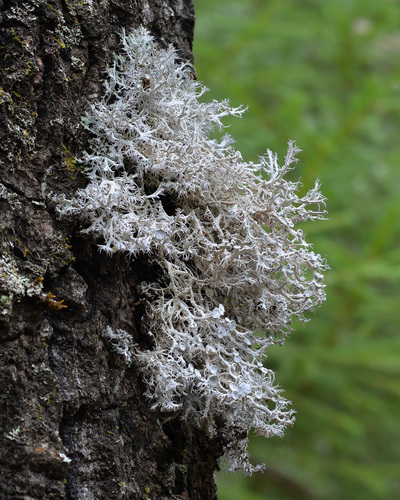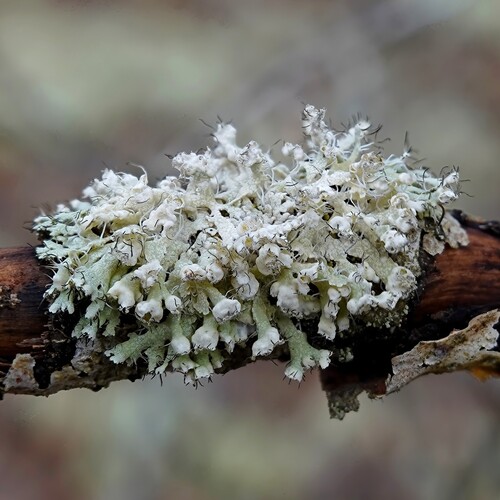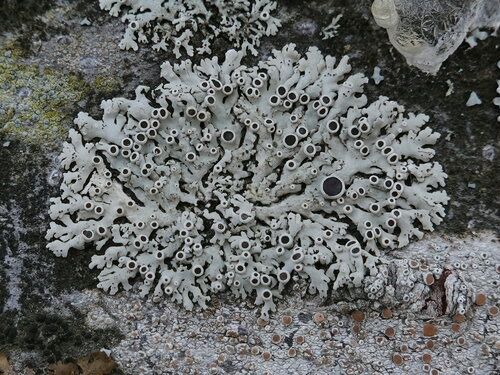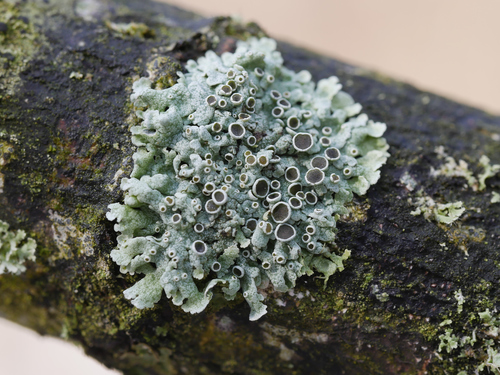
About Physcia caesia (Hoffm.) Fürnr.
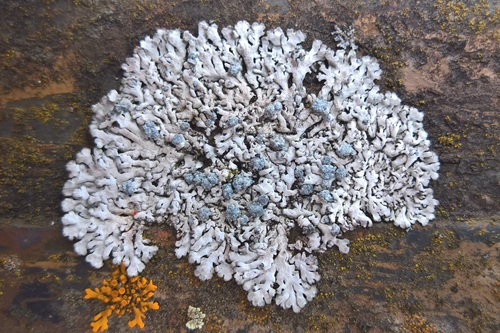
Physcia caesia (Hoffm.) Fürnr. is a foliose lichen that forms small rosettes. Mature individuals typically reach 2–3 cm (0.79–1.18 in) across, though they can grow up to 7 cm (2.8 in) in diameter. Its thallus (body) is pale gray that darkens toward the center, and it adheres tightly to the substrate it grows on. The lobes of the thallus are convex and linear, usually 0.5–1.0 mm (0.02–0.04 in) wide, occasionally reaching 2 mm (0.08 in) across. Specimens from some regions, including Greenland, can be much darker, with thalli ranging from gray to dark gray, and may have either broader or narrower lobes. The upper surface of the lichen is covered in white spots, though this marking is not always visible. It produces blue-gray soredia (clumps of fungal hyphae wrapped around photobiont cells) that accumulate in round mounds called soralia across the upper thallus. The lower surface of the thallus ranges from white to brown, and has short, dark rhizines. Apothecia (sexual reproductive structures) are only rarely produced by Physcia caesia. When present, they are black discs up to 2 mm (0.08 in) across, with prominent thalline margins (meaning the thallus extends around the edges of the apothecium) and a coating of grayish pruinescence. Each ascus holds 8 spores, which are thick-walled and brown, measuring 18–25 μm (0.00071–0.00098 in) by 6–10 μm (0.00024–0.00039 in). Its photosynthetic partner (photobiont) is the green alga Trebouxia impressa, a species that associates with many other Physcia lichens. Both the cortex and medulla of the lichen react positively to potassium hydroxide (K), turning yellow. They also react positively to para-phenylenediamene (Pd), also turning yellow. No reaction occurs with calcium or sodium hypochlorite (bleach, C), or with KC (potassium hydroxide followed immediately by bleach). Chemical compounds produced by the lichen include atranorin and zeorin. Physcia caesia has a wide distribution across much of the world, occurring in Arctic, boreal, and temperate vegetation zones. It is widely distributed across Europe, is one of the most common Physcia species in Greenland, and is abundant throughout Britain. While it occurs across most of North America, it is absent from central and southeastern United States, parts of the Great Basin, and northern Alaska. In South America, it is found in Argentina, Chile, and Peru; it is common and widespread in temperate areas of the continent, but occurs only rarely and exclusively at elevations above 3,700 m (12,100 ft) in tropical regions. It occurs patchily across Asia, including in India, Bhutan, Nepal, and Japan, and also occurs in East Africa. It is described as cosmopolitan in New Zealand, has been reported from multiple sites in southeastern Australia and Tasmania, and also grows in Antarctica. It is common on calcareous substrates, growing on limestone (including tufa) and concrete. It also grows on basaltic and siliceous rock, as well as on bone. It is particularly common on rocks where birds perch and defecate. It is uncommon on bark, but in the Colorado Rocky Mountains, it is one of the predominant lichens growing on juniper trees, where it occurs mostly within 0.1 m (3.9 in) of the ground on the northern and eastern sides of trunks. In Antarctica, it grows on mosses, soil, and gravel, and may be one of the species that contributes to forming soil crusts on the continent. In California, it is found in montane and subalpine forests at elevations between 1,000–8,000 ft (300–2,440 m). Physcia caesia tolerates a diverse range of locations, growing on vertical, angled, and horizontal surfaces, as well as rocky overhangs. It grows on both dry stone and stone kept moist by seepage, and can tolerate irregular submergence underwater. It survives hot desert conditions, primarily growing on the north-facing sides of slopes. It also thrives in cold conditions, and can carry out photosynthesis at temperatures as low as −14 °C (7 °F). Like many rock-growing lichens, Physcia caesia can accumulate essential nutrients including nitrogen, phosphorus, potassium, and iron from its substrate, as well as from rainwater and atmospheric dust. Its hyphae can extend up to 17 mm (0.67 in) into the substrate. It is a nitrophyte, and can tolerate higher levels of atmospheric ammonia than many other lichen species, because it can survive on substrates with a higher pH. It has been recorded growing on lead surfaces, likely weathered lead oxide. It is known to accumulate high concentrations of heavy metals, including chromium, zinc, copper, and iron. It grows slowly; one study measured an average growth of just 0.98 mm (0.04 in) per year for a studied colony. In Greenland, it often grows alongside other lichen species that tolerate nutrient-enriched environments, including Umbilicaria arctica, Polycauliona candelaria, Rusavskia elegans, Physcia dubia, and Rhizoplaca melanophthalma. In Poland, it is a member of bryophyte communities that grow on asbestos tile roofs, occurring with species such as Syntrichia ruralis, Orthotrichum anomalum, Grimmia pulvinata, and Schistidium apocarpum, among others. Foliose lichens like Physcia caesia have an intermediate sensitivity to air pollution: they are less sensitive than fruticose lichens, but more sensitive than crustose lichens. Physcia caesia can be found in cities, though it occurs at lower frequencies there than more pollution-tolerant lichen species. Like most lichens, Physcia caesia is affected by habitat loss from development, as well as by trampling or overgrowth of its growing sites. However, the preservation of old stone walls, buildings, and bridges can support its populations, even in urban areas. Physcia caesia is parasitized by several lichenicolous fungi, including Polycoccum galligenum, Polycoccum pulvinatum, Zwackhiomyces physciicola, and Bryostigma epiphyscium.