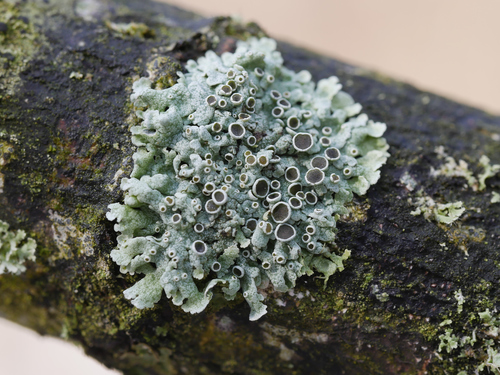
About Physcia aipolia (Ehrh. ex Humb.) Fürnr.
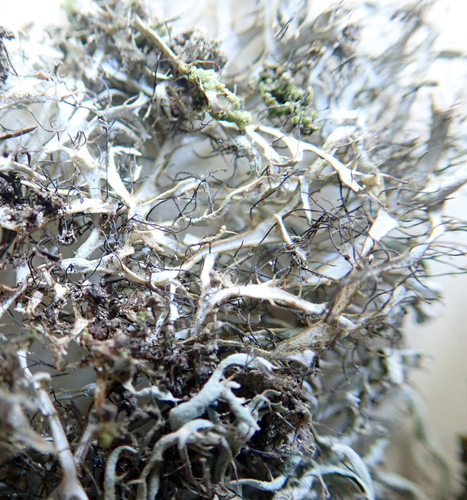
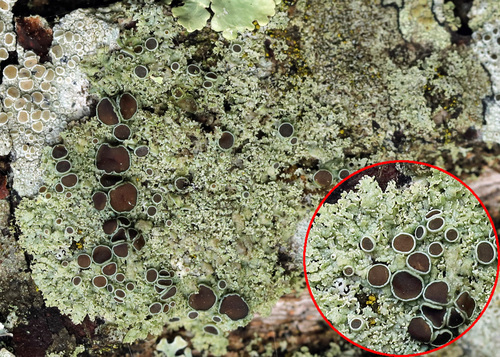
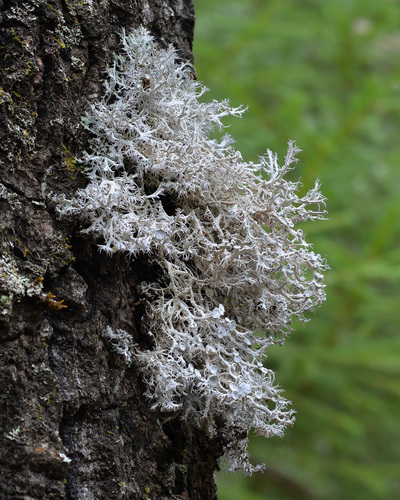
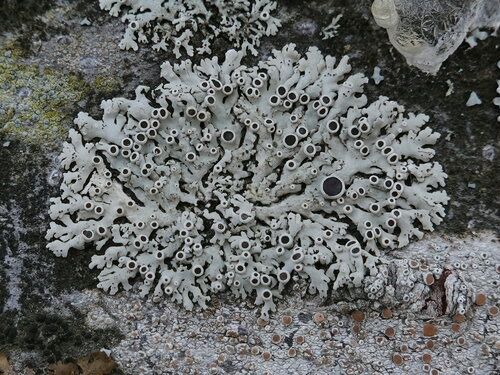
Commonly known as the hoary rosette lichen, Physcia aipolia (Ehrh. ex Humb.) Fürnr. has a pale blue to gray foliose thallus that typically grows to around 6 centimeters in diameter. This species lacks a specialized root structure, and does not produce soredia or isidia. It bears numerous apothecia with dark gray to black discs; these apothecia can reach up to 2 millimeters in diameter, and range in shape from flat to convex. The apothecia contain brown ascospores that measure 16-29 by 7-12 micrometers. The lower surface of the thallus is white to pale brown, and holds many pale rhizines. Physcia aipolia is a common lichen that typically grows in well-lit, nutrient-rich areas. It is most often found growing on a variety of tree bark and wood. This species holds a secure, apparently secure, or provisional conservation status. It has a broad distribution across North America, with confirmed occurrences ranging from Eastern Canada, Alaska, and California to Wisconsin, Michigan, and Missouri. Its growth is not limited by elevation, and it can be found at both sea level and higher elevation environments across the continent. It occurs in both rural and urban settings, and can tolerate environmental stress and desiccation. It is found in arctic, temperate, and boreal regions of both North America and Eurasia. Physcia aipolia is resistant to pollution. Because it lacks protective structures that would block uptake, environmental chemicals are reabsorbed by the lichen. The USDA has used it as a bioindicator to monitor air quality, specifically to measure regional levels of Al, Cr, Cu, Fe, N, and S for comparison against local air pollution data.