About Physcia adscendens H.Olivier
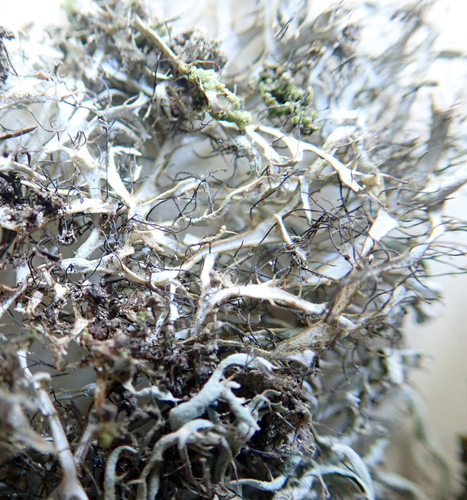
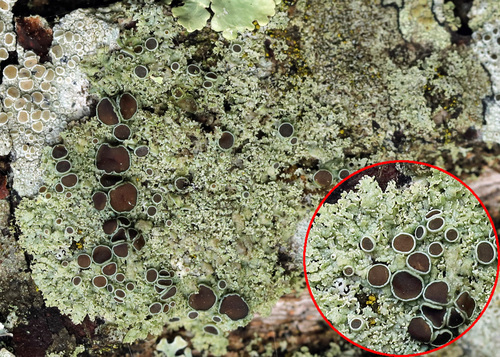
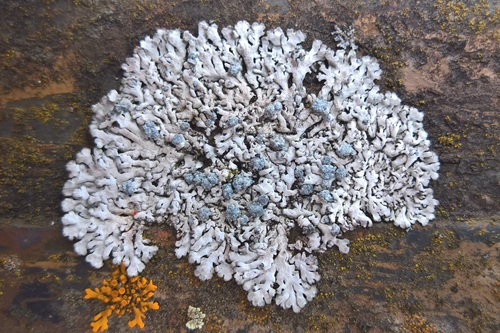
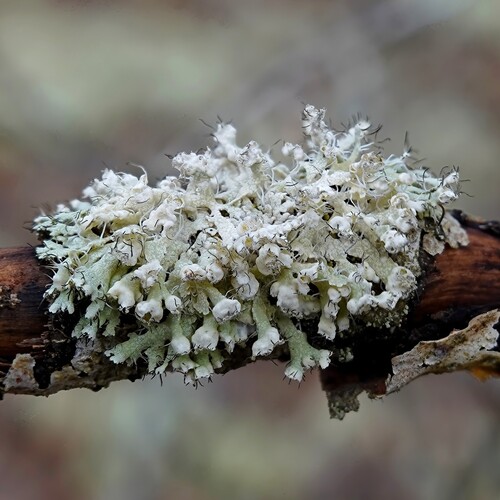
Physcia adscendens has a thallus that varies in colour from grey to greenish grey. It features narrow, hood-shaped lobes with upturned ends. Long cilia with dark tips grow from underneath these hoods. Pseudocyphellae cover the entire upper surface of the thallus. Soralia develop at the edges of the hoods, opening to expose soredia. Apothecia form on short stalks, and have black pruinose discs. Its spores measure 16–23 by 7–10 μm. Spot test results show the cortex gives a K+ (yellow) reaction, while the medulla is unreactive to K, C, and P spot tests. This reaction combination confirms the presence of atranorin in the species.
Physcia adscendens grows on both calcareous and siliceous rocks. It is common on limestone monuments, as well as on twigs and tree trunks. It is also often found colonising granite, including granite churches and granite monuments. In a Spanish study on post-fire colonisation success of multiple lichen species, Physcia adscendens was found to have one of the highest colonisation success rates, due to its ability to grow on a wide variety of substrates. It was able to grow on every substrate included in the study, and made up the largest percentage of biomass in the study area. In a 2011 study, thallus of Physcia adscendens was fed to nine snail species native to temperate Europe. The lichen was able to regenerate from approximately 40% of the snails' faecal pellets, indicating this may be an additional method of dispersal for the species. A 2025 survey of epiphytic lichens on 576 roadside trees in Amsterdam recorded 100 total lichen species; P. adscendens was counted among the very common epiphytes, occurring on more than 500 of the 576 surveyed trees, alongside Xanthoria parietina. The study authors placed P. adscendens at the core of a xerophytic–nitrophilous ecological group that corresponds to the Physcietum adscendentis association. This group forms lush mosaics on many urban tree trunks, and P. adscendens often persists as one of the last remaining lichens on severely desiccated bark where most other lichen species have died out. Known lichenicolous (lichen-dwelling) fungus species that use Physcia adscendens as a host are Lichenoconium lichenicolum and Phoma physciicola.