About Physalis viscosa L.
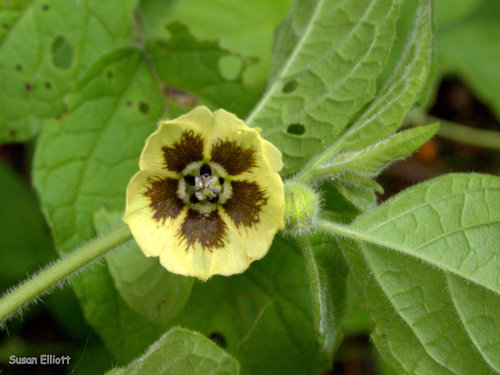
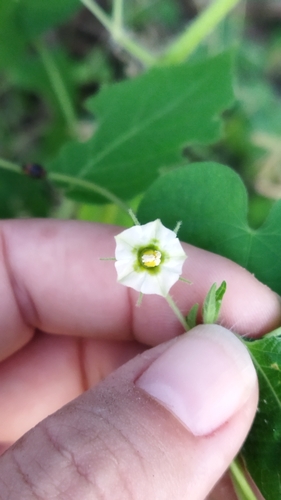
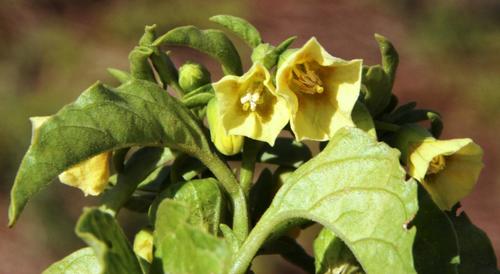
Physalis viscosa L. is a species of flowering plant in the nightshade family. It has many common names: in English, these include starhair groundcherry, stellate ground-cherry, and grape groundcherry; in Portuguese and Spanish, common names are arrebenta-cavalo, balãozinho, and camambú, with camambú derived from the Guaraní term akamambu, meaning "blister". This species is native to South America. On other continents, it is known as an introduced species, and it sometimes grows as a weed. It can grow in many types of habitat, including disturbed areas. It is a rhizomatous perennial herb, with a hairy stem that reaches a maximum height of about 40 centimeters. Its oval leaves measure 3 to 5 centimeters long, and have either smooth or toothed edges. Bell-shaped flowers, around 1.5 centimeters wide, bloom from the plant's leaf axils. These flowers are yellow with darker centers, and have five stamens tipped with yellow anthers. As the fruit develops, the calyx of sepals at the base of the flower enlarges. It becomes an inflated, ribbed, lantern-like structure 2 to 3 centimeters long that contains the plant's berry. Nutritional and medicinal use of Physalis viscosa has been documented across widespread areas of Bolivia, eastern Paraguay, and northern Argentina. Its use is particularly common in the Gran Chaco region. In this region, the Toba-Pilagá, Nivaclé, and Maká peoples eat the ripe fruits raw, while the Lengua-Maskoy people bake the fruits in embers or boil them before eating. Members of the Lengua-Maskoy group also prepare a liquid from crushed leaves placed in water, and drop this liquid into the affected eye to treat conjunctivitis and other eye ailments. Migrants to the region, including Anglican missionaries from England and Mennonite settlers fleeing persecution, make cooked and baked dishes from Physalis viscosa. In the Mennonite Plautdietsch dialect of the Gran Chaco, this plant is called Junitjoasche, which literally translates to June cherries. It is used to make jams, compotes, and pies, most notably Riebelplautz, a "Sunday pie" that is similar to crumble.