About Physalis pubescens L.
Physalis pubescens L. is a species of flowering plant in the nightshade family. It has many common names: in English these include husk tomato, low ground-cherry, and hairy groundcherry; in Spanish it is called muyaca and capulí. It is native to Brazil, and is also found across the southern half of the United States, Mexico, Central America, and most of South America. It occurs in other regions as an introduced species, and sometimes grows as a weed. It can grow in many types of habitat, including disturbed areas.
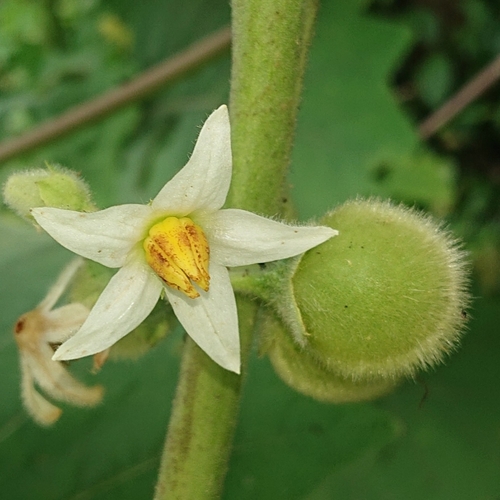
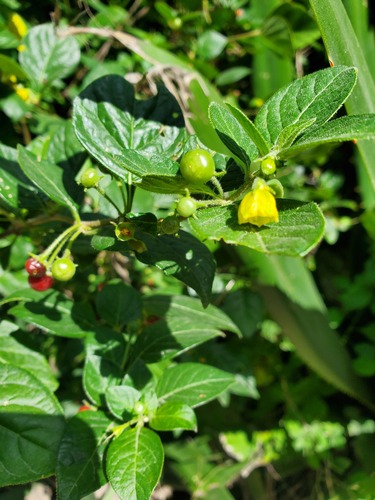
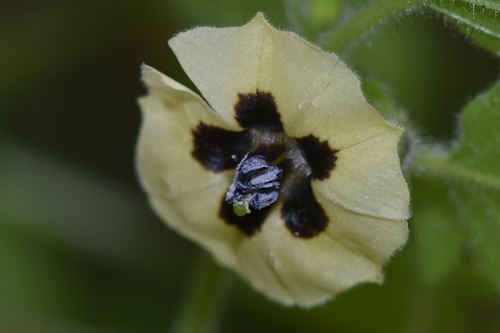
This is an annual herb that grows from a taproot, producing a glandular, densely hairy stem that reaches a maximum height of about 60 cm (24 in). Its oval or heart-shaped leaves are 3–9 cm (1.2–3.5 in) long, with either smooth or toothed edges. Bell-shaped flowers around one centimeter long bloom from the leaf axils. The flowers are yellow with five dark spots in their throats, and have five stamens tipped with blue anthers. As the fruit develops, the five-lobed calyx of sepals at the base of the flower enlarges into an inflated, ribbed, lantern-like structure 2–4 cm (0.79–1.57 in) long that contains the berry.
Ripe harvested fruits can be ripened for a few weeks and then used to make pie or jelly. Unripe fruits and the green parts of the plant are somewhat poisonous. Members of the Toba-Pilagá culture of Gran Chaco consume the fruit raw. Children of the Toba-Pilagá culture burst the still-calyx-enclosed fruits of Physalis pubescens var. hygrophila (Mart.) Dunal, a synonym of Physalis pubescens, as part of games: they place the fruit on one palm, then strike it with the other hand to make a popping noise.