About Physalis peruviana L.
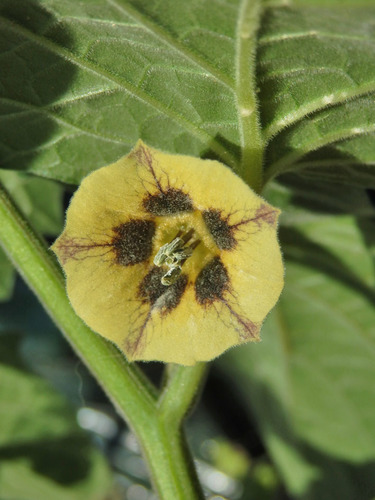
Physalis peruviana L. is closely related to the tomatillo. As a member of the Solanaceae plant family, it is more distantly related to a wide range of edible plants including tomatoes, eggplants, and potatoes. In temperate locations, P. peruviana grows as an annual, while it grows as a perennial in the tropics. When growing as a perennial, it develops into a diffusely branched shrub that reaches 1–1.6 m (3 ft 3 in – 5 ft 3 in) in height. It has spreading branches and velvety, heart-shaped leaves. Its hermaphrodite flowers are bell-shaped, drooping, and measure 15–20 mm (5⁄8–3⁄4 in) across. The flowers are yellow with purple-brown spots on the inside. After the flower falls away, the calyx expands and eventually forms a beige husk that fully encloses the fruit. The fruit is a round, smooth berry that resembles a miniature yellow tomato, measuring 1.25–2 cm (1⁄2–3⁄4 in) wide. When removed from its calyx, the fruit is bright yellow to orange, sweet when ripe, and has a characteristic, mildly tart flavor similar to grape. A key visible feature of this plant is the inflated, papery calyx that encloses each berry. The calyx is accrescent, meaning it continues growing until the fruit is fully mature. It starts at a normal size, but after the petals fall, it keeps growing until it forms a protective covering around the developing fruit. If the fruit is left inside the intact calyx husk, its shelf life at room temperature is around 30–45 days. The calyx itself is not edible. The center of genetic diversity for Physalis peruviana is the Andes Mountains of Ecuador, Chile, Colombia, and Peru. It naturally grows in forests, forest edges, and riparian areas. In its native region, it grows at high elevations between 500–3,000 m (1,600–9,800 ft). It can also be found growing at sea level in Oceania and Pacific islands, where it is widespread in subtropical and warm temperate conditions. Its overall latitude range is approximately 45°S to 60°N, and its general altitude range is from sea level to 3,000 m (9,800 ft). This plant has become invasive in some natural habitats, forming thickets, particularly in Hawaii and other Pacific islands. Dozens of ecotypes of this plant are recognized around the world, differentiated by plant size, calyx shape, and the size, color, and flavor of the fruit. Wild P. peruviana forms are thought to be diploid with 2n = 24 chromosomes, while cultivated forms include varieties with increased ploidy that have 32 or 48 chromosomes. Unripe raw fruits, flowers, leaves, and stems of Physalis peruviana contain the alkaloids solanine and solanidine, which can cause poisoning if ingested by humans, cattle, or horses. Physalis peruviana has been widely introduced into cultivation across tropical, subtropical, and temperate areas, including Australia, China, India, Malaysia, and the Philippines. P. peruviana grows best with an annual average temperature between 13 to 18 °C (55 to 64 °F), and can tolerate temperatures as high as 30 °C (86 °F). It grows well in Mediterranean climates, and is hardy to USDA hardiness zone 8, which means it can be damaged by frost. It grows well with annual rainfall between 800–4,300 mm (31–169 in) as long as the soil is well-drained. It prefers full sun or partial shade, grows in well-drained soil, and grows vigorously in sandy loam. This plant is easily grown from seeds, which are produced in abundance — each fruit holds 100 to 300 seeds. However, seeds have low germination rates, so thousands of seeds are required to sow one hectare. Plants grown from year-old stem cuttings will flower early and produce good yields, but are less vigorous than plants grown from seed.