About Physalis nicandroides Schltdl.
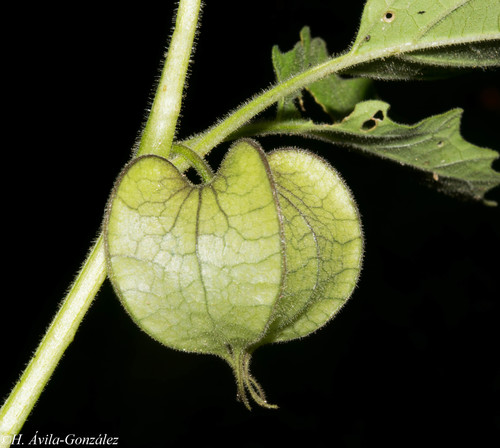
Physalis nicandroides Schltdl. is an erect, branched, annual herb that grows up to 1 m (3 ft 3 in) tall. The plant is covered in hairs, some of which are glandular, giving it a musky scent. Its leaf blades range from broadly egg-shaped to heart-shaped, reaching up to 18.4 cm (7.2 in) long and 16 cm (6.3 in) wide. Leaf tips are pointed, the two sides of the leaf base are often asymmetrical and frequently do not meet at the stem, and leaf margins can be variously toothed or smooth. Single flowers grow from stems on slightly drooping peduncles that are up to 8 mm (0.31 in) long. The bell-shaped corollas are up to 6 mm (0.24 in) wide, creamy whitish, and marked with five distinct greenish spots at the throat. The pollen-producing anthers that emerge from the throat are noticeably blue to blue-green. After the corolla falls away to leave the developing fruit, the peduncles thicken and elongate to up to 1.4 cm (0.55 in). As the flower's ovary matures, the calyx expands and inflates to completely enclose the resulting berry, forming a shape that resembles a Chinese lantern. The mature fruiting calyx is strongly 5-angled, up to 2.6 cm (1.0 in) wide, and turns golden brown and leathery once it dries. The berry inside the calyx is dark brown, up to 1.5 cm (0.59 in) in diameter, and holds numerous seeds. Based on observation records mapped on iNaturalist, Physalis nicandroides is native across most of Mexico, extending south through Central America into most of Costa Rica, and it has been introduced to Paraguay. In Mexico, this plant is a common weed growing along roadsides and near crop fields at elevations ranging from 120 to 2000 m (~400 to 6500 feet); in the state of Guerrero, it is also reported to grow in moist ravines. Physalis nicandroides fruits are combined with ingredients like onion, garlic, cilantro, and chili pepper to make salsas. However, the fruits contain tannins that give them a slightly bitter taste, which prevents some people from using them, while others enjoy the flavor. In Mexican traditional medicine, a decoction made by boiling the root of this species is gargled to relieve pain from infected molars. In Guerrero, it is used to reduce symptoms of edema. In Puebla, the leaves are used to treat conjunctivitis. In the states of Morelos and Guerrero, new mothers are bathed in water infused with this plant. Research shows that a specific steroid obtained from Physalis nicandroides inhibits HIV transcription, which means it may potentially help in the treatment of HIV/AIDS.