About Physalis heterophylla Nees
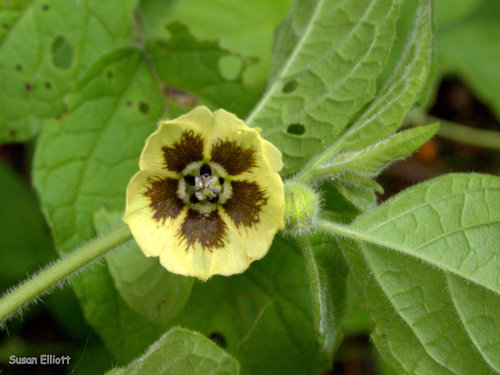
Identification: Physalis heterophylla is a perennial plant and one of the taller-growing North American members of the Physalis genus, reaching a maximum height of 50 cm. Its leaves grow in an alternate arrangement, have petioles up to 1.5 cm long, and are ovate in shape, usually with a cordate base — a feature that is especially prominent on mature leaves. Mature leaves measure 6–11 cm in length. Every species in the Physalis genus has at least one trait that makes it easy to distinguish in the field. For P. heterophylla, the stems and leaves have glandular pubescence, which creates the "clammy" texture that the species' name references. This plant also has distinctive thick rhizomes that grow horizontally relative to the main stem. Some sources recognize four distinct varieties based primarily on leaf variation: P. heterophylla var. heterophylla, which has thin leaves with dentate margins; P. heterophylla var. clavipes, which has thick, conspicuously veined leaves with sparse tooth-like protrusions on otherwise entire margins; P. heterophylla var. ambigua, which has thick, conspicuously veined leaves with dentate margins; P. heterophylla var. nycangienea, which has thin leaves with sparse tooth-like protrusions on otherwise entire margins. Flowers grow on simple inflorescences that emerge from leaf axils. Petals are yellow externally, and yellow internally with purple markings extending upward from the base of each petal. Flowers are funnel-shaped, with five fused petals. There are five reticulated sepals that enlarge after flowering to protect the maturing fruit. There are five stamens, with yellow anthers and purple filaments. Open flowers face downwards, and are approximately 2.5 cm in diameter. The fruits match the typical form for the genus, similar in appearance to a tomatillo, with a slightly bitter taste, though they are fully edible when ripe. Toxicity: Except for the mature edible fruit, all parts of P. heterophylla contain toxic levels of solanine, which is poisonous to humans and animals. Symptoms of solanine poisoning include headache, stomach pain, lowered body temperature, dilated pupils, vomiting, diarrhea, circulatory and respiratory depression, and loss of sensation.