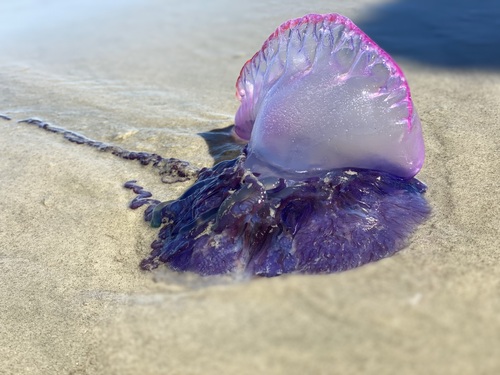
About Physalia physalis (Linnaeus, 1758)
Physalia physalis (Linnaeus, 1758), commonly called the Portuguese man o' war, is a siphonophore and a colonial cnidarian. Like all siphonophores, each man o' war is a colonial organism made of many small specialized units called zooids, which hang in clusters beneath a large, gas-filled float called the pneumatophore. Each zooid in the colony evolutionarily derives from one of the two basic cnidarian body plans: polyp or medusa. In non-colonial cnidarians, these body plans form entire individual organisms; for example, a jellyfish is a medusa, while a sea anemone is a polyp. All zooids in a man o' war develop from the same single fertilized egg, so they are genetically identical. They stay physiologically connected their entire lives, and function like organs in a single shared body. This means that from an ecological perspective, a Portuguese man o' war counts as one single organism, but from an embryological perspective, it is made up of many distinct individuals. Seven different types of zooids have been documented in the man o' war, and all types depend on one another for survival, each carrying out a different specialized function: examples include digestion (gastrozooids), reproduction (gonozooids), and hunting (dactylozooids). Three of these zooid types are medusoid: gonophores, nectophores, and vestigial nectophores. The remaining four are polypoid: free gastrozooids, tentacle-bearing zooids, gonozooids, and gonopalpons. Naming and categorization of these zooids varies between different researchers, and much about the embryonic and evolutionary relationships between zooid types remains unclear. As the colony grows, new zooids are added via budding. Long tentacles hang below the float as the animal drifts, to catch prey by stinging it before dragging it up to the colony's digestive zooids. The main reproductive zooids, called gonophores, sit on branching structures called gonodendra. Each gonophore produces either sperm or eggs. In addition to gonophores, each gonodendron also holds several other zooid types: gastrozooids, palpons (tentacle-less gastrozooids), nectophores (which are speculated to let detached gonodendra swim), and vestigial nectophores (also called jelly polyps; their function is unknown). The pneumatophore, or bladder, is the man o' war's most visible and recognizable part. It is filled with gas produced by a gas gland, and can grow to over 12 inches (30 cm) long, 5 inches (13 cm) wide, and 5.9 inches (15 cm) tall. The pneumatophore acts as both a flotation device and a sail, letting the animal move along with prevailing winds. Most of the gas inside the pneumatophore is air that diffuses in from the surrounding atmosphere, but it also contains up to 13% carbon monoxide that the animal actively produces. If the man o' war is attacked at the water surface, it can deflate its pneumatophore to temporarily submerge. The colony hunts and feeds through the cooperation of two zooid types: tentacular palpons, from which the tentacles grow, and gastrozooids. The tentacles are typically around 30 ft (10 m) long, but can grow to over 100 ft (30 m). Every tentacle holds tiny, coiled, thread-like structures called nematocysts. When they come into contact with another organism, nematocysts trigger and inject venom, stinging, paralyzing, and killing prey such as molluscs and fishes. Gastrozooids then surround and digest this food by secreting digestive enzymes. Large groups of Portuguese man o' war, sometimes numbering over 1,000 individuals, can reduce local fishery populations. The Portuguese man o' war belongs to the neuston, the group of organisms that live at the surface of open water. This habitat exposes the community to a unique set of environmental conditions, including prolonged exposure to intense ultraviolet light, risk of drying out, and rough sea conditions. The gas-filled pneumatophore stays at the water surface, while the rest of the colony remains submerged. The man o' war has no way to propel itself; it moves passively, driven by winds, currents, and tides. Winds can push these animals into bays or onto beaches. Portuguese man o' war are well known to beachgoers for the painful stings their tentacles deliver. Because they can still sting even after washing up on shore, finding a beached man o' war often leads to temporary beach closure. Man o' war colonies are dioecious, meaning every individual colony is either male or female. Gonophores that produce either sperm or eggs (matching the sex of the parent colony) grow on a tree-like gonodendron structure, which is thought to detach from the main colony during reproduction. Eggs and sperm are released directly from the gonophores into the open water. Neither fertilization nor early development has been directly observed in the wild, so it is still unknown at what depth these processes occur. A fertilized man o' war egg develops into a planula, which buds off new zooids as it grows, gradually forming a new colony. This early development takes place underwater, and its sequence has been reconstructed by comparing different stages of planulae collected at sea. The first two structures to emerge are the pneumatophore (sail) and a single early feeding zooid called a protozooid. Gastrozooids and tentacle-bearing zooids are added later. Eventually, the growing pneumatophore becomes buoyant enough to bring the immature colony up to the water surface.

