About Physalaemus olfersii (Lichtenstein & Martens, 1856)
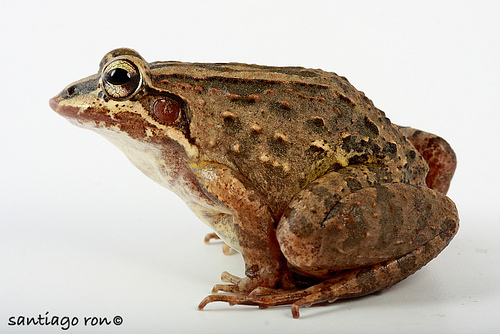
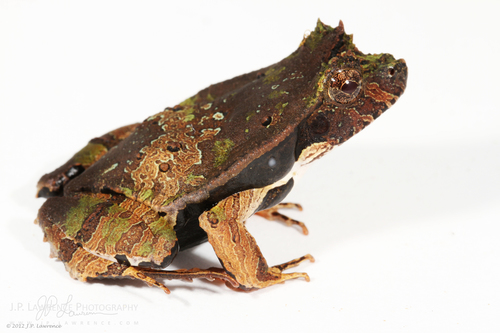
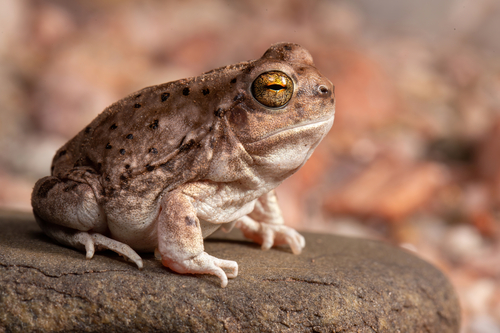
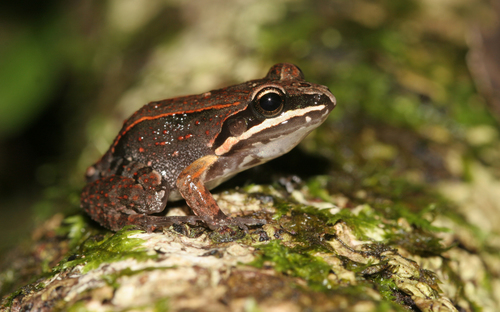
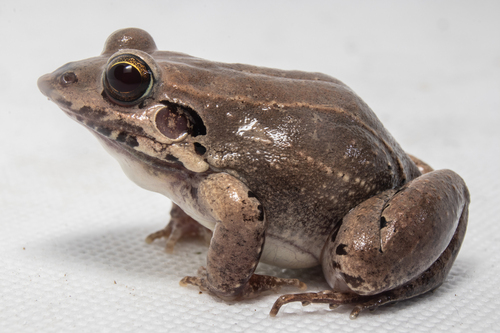
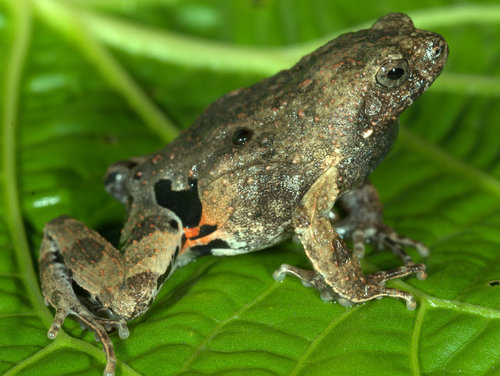
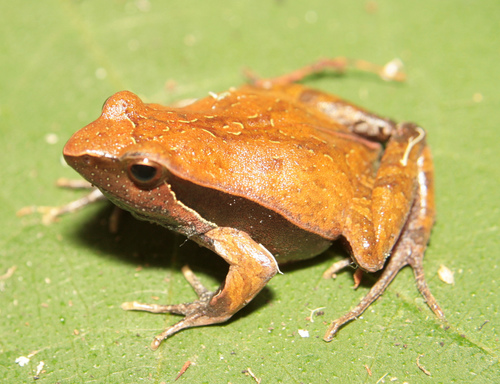
Adult male Physalaemus olfersii measure 26–36 mm (1.0–1.4 in) and adult females measure 22–41 mm (0.9–1.6 in) in snout–vent length. This species has a moderately robust body, and a head that is longer than it is wide. In dorsal view, the snout ranges from pointed to sub-elliptical, and it appears acute when viewed from the side. Both the tympanum and the supra-tympanic fold are indistinct. Fingers and toes are thin and long, with slightly expanded tips, and have no webbing. Dorsal coloration ranges from light brown to gray, marked with small, irregular, scattered brown blotches. A median line runs across the posterior two-thirds of the dorsum. The loreal region is dark brown with scattered white dots. A black stripe extends from the postorbital region to the anterior margin of the inguinal gland. A weak white line runs along the canthus rostralis, becoming clearly defined along the upper eyelid border and the dorsolateral fold. The gular region is dark gray with white dots that extend into the anterior abdomen; the posterior abdomen is uniformly light brown. Males of this species have a subgular vocal sac. Physalaemus olfersii is found in primary and secondary forest at elevations below 1,200 m (3,900 ft). It inhabits leaf litter, the ground, and low vegetation. Breeding occurs in both temporary and permanent ponds. It is a common species, though it is likely threatened by habitat loss.