About Phymata crassipes (Fabricius, 1775)
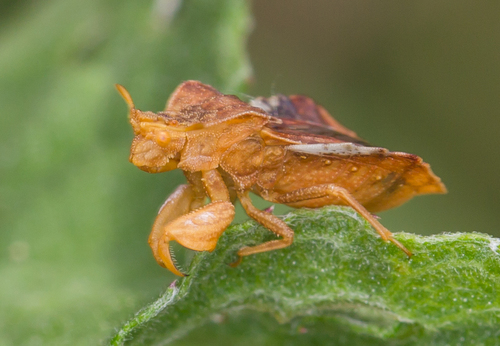
Adult Phymata crassipes reach a body length of approximately 7–9 mm. Their bodies are ornamented with small protrusions. They have a triangular scutellum that is shorter than the pronotum, which lacks prominent tubercles. This species has fully functional wings, clubbed antennae, enlarged fore femora, and an enlarged abdomen. The edge of the abdomen extends outward beyond the edges of the wings. These insects are beautifully camouflaged, and capture prey using their specialized raptorial fore legs. Basic body coloration differs by sex: males are dark reddish-brown, while females are a lighter yellow-brown. Antennae structure also differs between sexes: male antennae end in a cylindrical joint that is thicker and longer than all other antenna segments, while female antennae end in a more club-shaped joint that is not as long as the preceding segments. This species is quite similar to Phymata monstrosa, which occurs in southwestern Europe; P. monstrosa can be distinguished by the presence of small bumps on the femora of its middle and hind legs. Phymata crassipes is widespread across the Palearctic realm. It can be found in the Mediterranean region, North Africa, and Central Europe, ranging eastward to Korea, northern China, and Siberia. It is not present in northwestern Europe or the British Islands. These bugs live in dry, sunny biotopes, most commonly calcareous grasslands, rocky heaths, south-facing slopes, and forest edges.