About Phymanthus crucifer (Le Sueur, 1817)
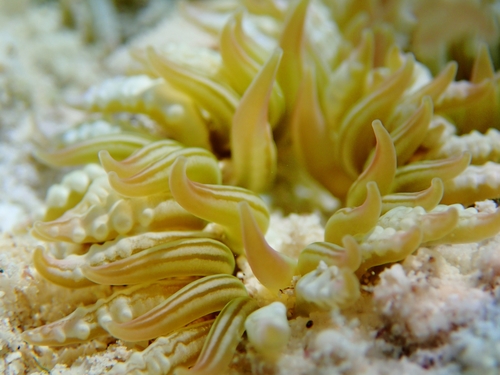
Phymanthus crucifer, commonly called the rock flower anemone, flower anemone, red beaded anemone, or beaded anemone, is a species of sea anemone that belongs to the family Phymanthidae. It has been described as closely similar to Heteractis aurora in multiple characteristics, and commonly has tentacles with swollen cross-bars that hold large clusters of stinging nematocysts. Even so, P. crucifer can also occur with smooth tentacles, and these smooth individuals may sometimes be found right next to specimens that have the characteristic swollen cross-bars. Its flat oral disk, edged with around 200 short tentacles, can grow up to 15 centimetres (5.9 in) across. When fully extended, the column of large individuals can reach 15 to 20 centimetres (5.9 to 7.9 in) in length, with a diameter of 51 to 76 millimetres (2.0 to 3.0 in); most individuals only reach half this length and diameter. P. crucifer shows a very wide range of color variation, with colors ranging from sandy or buff to dull green and even red. The base of its column is usually cream-colored with red streaks, and turns more grey toward the top of the column. Rows of light and dark stripes and bumps radiate outward from its mouth, shifting in color from bright green at the center to brown, lavender, yellow, or white toward the outer edge. It has bright red suckers on its column, which debris can attach to for camouflage. P. crucifer lives on sandy bottoms in the Caribbean Sea and can be found throughout the West Indies. The main body, or column, of this anemone is usually buried in sand, anchored to a rock below the sand surface; this allows the anemone to pull itself fully back into the substrate when disturbed. P. crucifer is documented as a species often found near coral reefs and rocky ledges, and it can withdraw into crevices and holes when it is agitated. Observations show that the reproductive cycle of this species is prolonged, longer than an annual or biannual cycle. This difference suggests that reproductive cycles of tropical sea anemones differ from those of sea anemones that live in cooler water. P. crucifer can reproduce sexually, with its eggs developing into larvae inside the parent individual. P. crucifer is a dioecious species, meaning it has separate male and female individuals, and produces large eggs.

