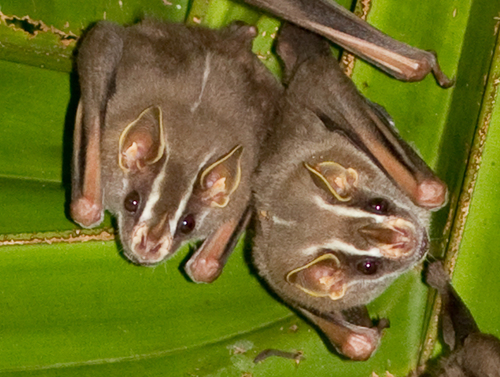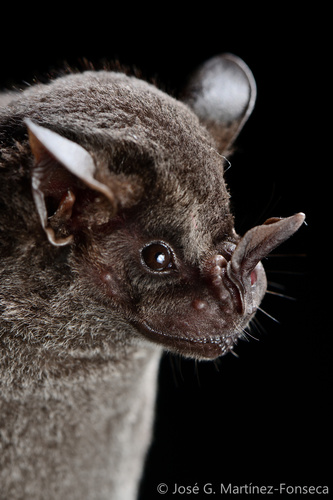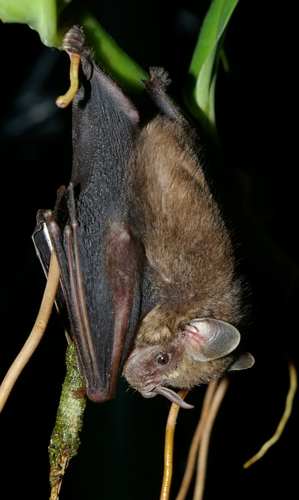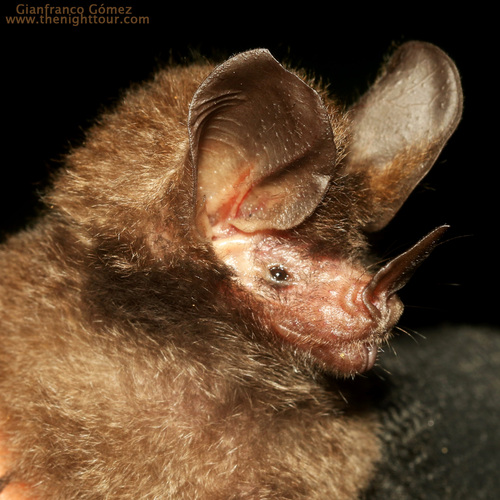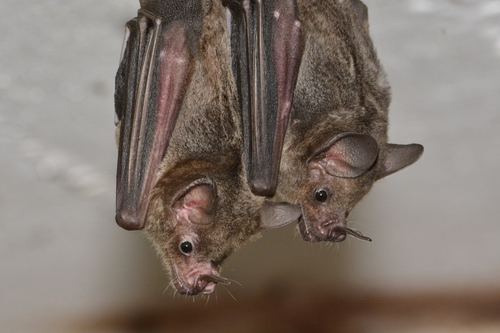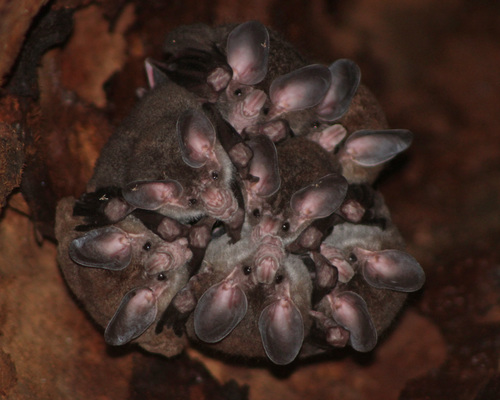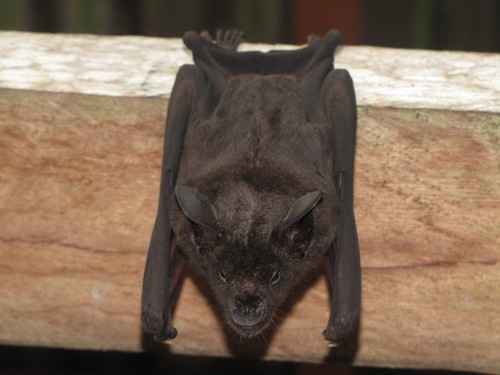
About Phyllostomus hastatus (Pallas, 1767)
The greater spear-nosed bat, Phyllostomus hastatus (Pallas, 1767), is a bat species belonging to the family Phyllostomidae, native to South and Central America. It is one of the larger bat species found in this region, and has an omnivorous diet. P. hastatus lives in tropical regions of the Americas. Its range extends from Guatemala and Belize southward to Peru, Bolivia, Paraguay, northern Argentina, and Brazil. It also lives in Trinidad and Tobago, and on Margarita Island in Venezuela. While it is most commonly found near streams and other bodies of water, these bats also occur in drier areas, and inhabit both open and forested regions. The reproductive pattern of P. hastatus can vary across its range. While this bat generally only reproduces once per year, lactating females have been observed year-round, which suggests that some individuals may reproduce more often. Females give birth to only one young at a time, and the species has a very low reproduction rate. Social reproductive constancy is almost always maintained even when the dominant male changes. McCracken and Bradbury (1977, 1981) characterized the species' reproduction cycle as: oestrous from February to April, pregnancy from May to mid-July, lactation from mid-July to late October, and anoestrous from late October to February. It has been hypothesized that female P. hastatus eat vertebrates to obtain extra protein for lactation.