About Phylloscopus inornatus (Blyth, 1842)
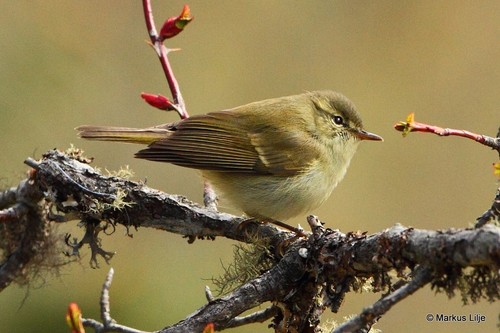
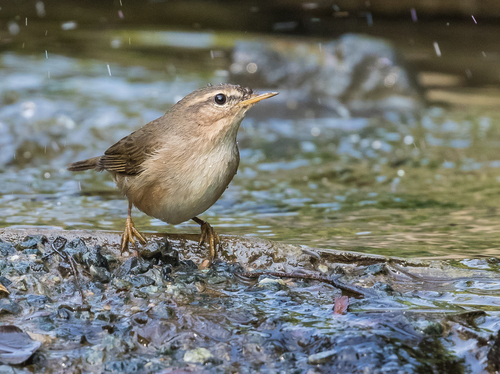
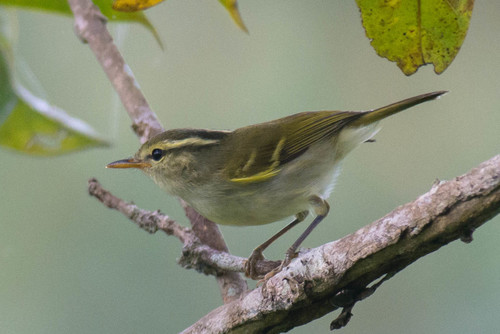
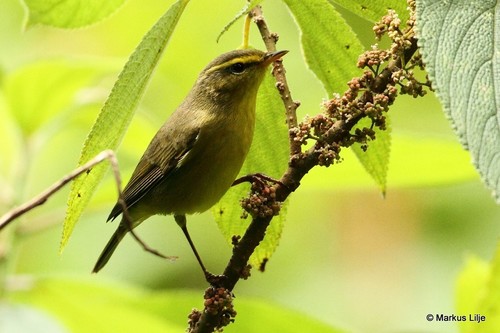
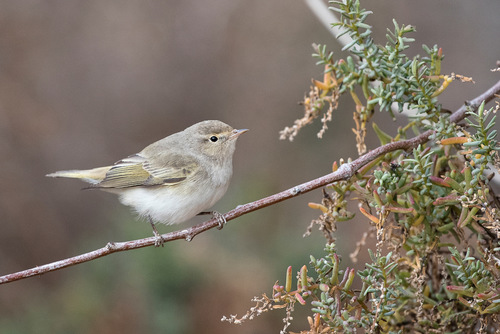
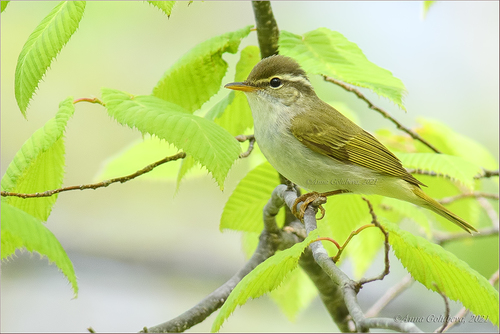
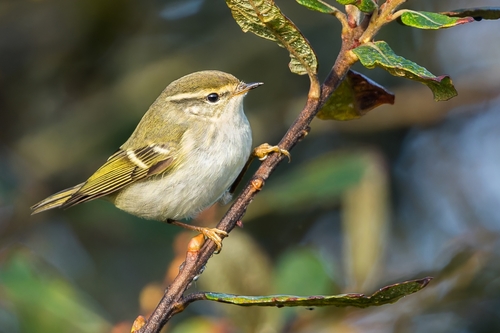
This species is one of the smaller Old World warblers, measuring 9.5–11 cm in length and weighing 4–9 g. It is distinctly smaller than a chiffchaff, but slightly larger than Pallas's leaf warbler. Like many other leaf warblers, it has overall greenish upperparts and white underparts. It also has prominent double wing bars formed by yellowish-white tips to the wing covert feathers, with a long bar on the greater coverts and a short bar on the median coverts. It has yellow-margined tertial feathers and a long yellow supercilium. Some individuals show a faint paler green central crown stripe, though many do not display this feature. This bird is not shy, but its arboreal lifestyle makes it difficult to observe, and it is almost constantly in motion. Its song is a high-pitched medley of whistles; its call is piercing, often a disyllabic "tseeweest", and is strikingly loud for the bird's small size. The only species this bird is easily confused with is the similar-looking Hume's leaf warbler (P. humei). In the limited areas where their ranges overlap, Hume's leaf warbler has duller colours, a faint second wing bar, and dark legs and lower mandible. Their songs and calls are clearly distinct: Hume's leaf warbler has a more chirping "chwee" call. This species can easily be distinguished from Pallas's warbler, as it does not have the conspicuous yellow central crown stripe and rump patch that Pallas's warbler shows. Like most warblers, it is insectivorous. The nest is built in dense vegetation, often at the base of a tree or old stump. Females lay two to four eggs, occasionally more. Eggs hatch after 11–14 days, and chicks fledge when they are 12–13 days old. This is an abundant bird found in lowland and montane forests and woodlands; it may also be found in more open woods particularly during winter. Its breeding range extends from just west of the Ural Mountains eastwards to eastern Siberia, Mongolia and Northeast China. Its winter habitat is lowland broadleaf or coniferous forest, ranging from West Bengal and Assam in northeastern India east through southern China to Taiwan, and through Bangladesh south to the Malay Peninsula. In summer, it occurs at altitudes of up to 2,440 m, and in winter, up to 1,525 m. The European breeding population west of the Urals has expanded westwards in recent decades: in 1950 it was described as 'fairly scarce', but by 1990 it was 'locally abundant' with 45,000–46,000 pairs. Small numbers, most likely from the western end of the breeding range, regularly winter in western Europe. These birds arrive in Great Britain in late September and October after a 3,000–3,500 km migration from the Urals, which is a markedly shorter distance than the 5,500–6,000 km flight they would need to reach the species' normal wintering areas in southeastern Asia. Exact numbers in this western European wintering population are unknown, but typically several hundred are found arriving in Great Britain each autumn; given their unobtrusive behaviour, this count is probably only a fraction of the total. While these birds were widely considered vagrants in the past, they are now thought to undertake a normal regular migration, and are able to take advantage of the mild oceanic climate winters on the western fringes of Europe for wintering. As a common species across most of its wide range, the yellow-browed warbler is not considered threatened by the IUCN. Hume's leaf warbler overlaps its breeding range with yellow-browed warbler in the western Sayan Mountains, but the two species apparently do not hybridise. Their lineages diverged roughly 2.5 million years ago.