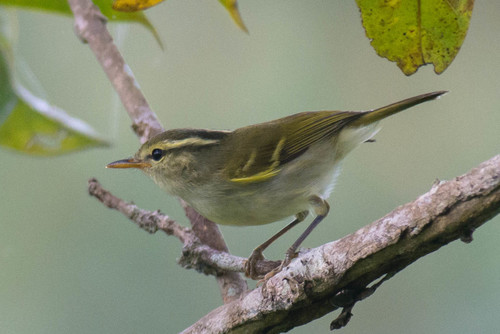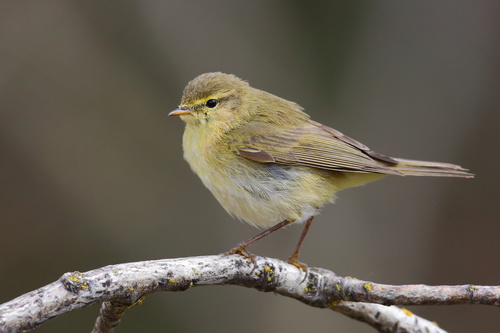
About Phylloscopus ibericus Ticehurst, 1937
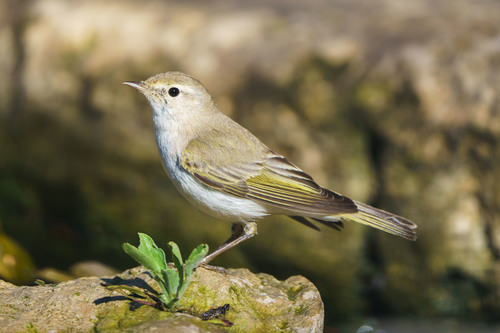
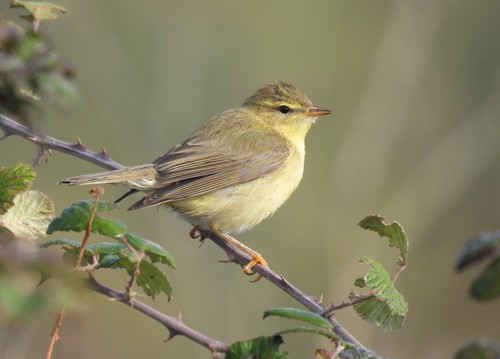
Identification: The Iberian chiffchaff (Phylloscopus ibericus) can be distinguished from the common chiffchaff primarily by its song, though it also has clear plumage differences. Its upperparts are a cleaner green with no brown tint; it has a yellow breast and white belly, making its overall appearance closer to the willow warbler (P. trochilus) than the common chiffchaff. This resemblance to the willow warbler is strengthened by the presence of a distinct dark eyestripe.
Its vocalization is similar to that of the common chiffchaff, but its song is not disyllabic and includes additional elements. It does produce a chiff-chaff-like call, but the full song is faster and more monotonous than the common chiffchaff's song, interspersed with repeated rattles and long, drawn-out whistles. The song has been transcribed as "chiff-chiff-chiff-chiff-dr-dr-dr-dr-swit-swit-swit".
Distribution and habitat: The Iberian chiffchaff is a summer visitor that breeds in Spain, Portugal and Morocco. Within the Iberian Peninsula, it breeds in the west and north; the northern Spanish breeding population extends from Galicia to Navarre in the Pyrenees, with a small number of breeding individuals in Pyrénées-Atlantiques, France, and separate scattered populations in the mountains of southern Spain. In Portugal, it occurs mainly in the northern regions of Trás-os-Montes and Alto Douro, with another distinct breeding population in southern Portugal from Estremadura south to the Algarve. It also breeds in northern Morocco.
It occupies humid areas. In the southern parts of its range, it is associated with riparian habitats. In the northern parts of its range, it occurs in deciduous woodland with well-developed undergrowth, and is less dependent on riparian habitats.