About Phylloscopus humei (W.E.Brooks, 1878)
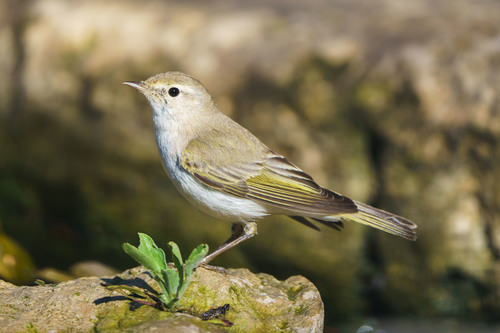
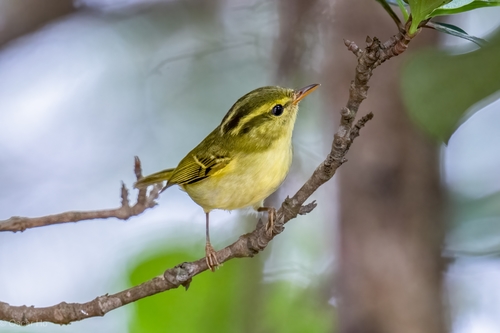
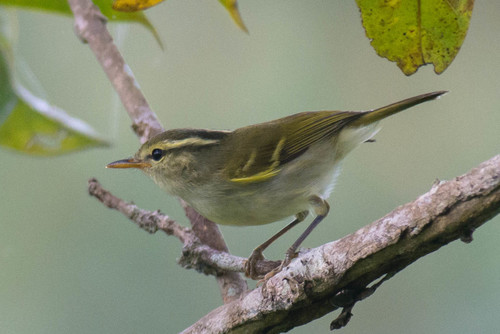
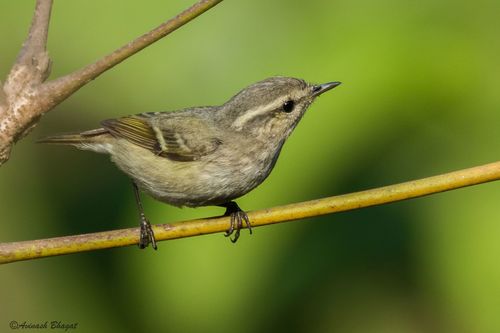
Hume's leaf warbler (scientific name Phylloscopus humei, first described by W. E. B. Brooks in 1878) is one of the smallest Old World warblers. Like most other leaf warblers, it has greenish upperparts and off-white underparts. It bears a strong resemblance to the closely related yellow-browed warbler (P. inornatus), sharing a long supercilium, crown stripe, and yellow-margined tertial remiges. However, Hume's leaf warbler can be distinguished by only one prominent light wing bar, with just a faint vestige of a second shorter wing bar, overall duller plumage, a dark lower mandible, and dark legs. Its song is buzzing and high-pitched, and the clearest difference from the yellow-browed warbler is its more disyllabic call. While eastern and western populations of Hume's leaf warbler already show noticeable differences in mtDNA sequences and calls, their songs do not differ. These populations are reproductively isolated only by allopatry and are not usually classified as separate species. This is a common species of mountain woodlands, found at altitudes up to 3,500 m above sea level. Its breeding range extends from the Hindu Kush and Karakoram east and north to the Tien Shan in China and the Altay Mountains in Mongolia. The fully allopatric subspecies mandellii, also called Mandell's leaf warbler or eastern Hume's warbler, occurs on the eastern Tibetan Plateau; this subspecies is sometimes split into a full species, in which case the nominate subspecies is called western Hume's leaf warbler. Both populations migrate across the Himalayas to winter in India and adjacent regions, and the species has also been recorded in the Kutch region. Especially during autumn migration, this tiny warbler is prone to vagrancy as far as western Europe, despite a 3,000 km distance from its breeding grounds, and it is a rare vagrant in late autumn and winter in Great Britain. Non-breeding adults may wander widely in summer; Mandell's leaf warblers are fairly common summer visitors to subtropical and temperate montane humid forests of Bhutan, between 2,000 and 3,500 m ASL, dominated by Bhutan fir (Abies densa) or Himalayan hemlock (Tsuga dumosa) and rhododendrons, though this subspecies is not a regular breeder in Bhutan. Hume's leaf warbler is not a shy species, but its arboreal lifestyle and cryptic colouration make it difficult to observe. It is constantly in motion. Like most Old World warblers, this small passerine is insectivorous, and it builds its nest on the ground. As a common species across most of its wide range, Hume's leaf warbler is not considered threatened by the IUCN. It was recently split from the yellow-browed warbler (Phylloscopus inornatus) based on differences in morphology, bioacoustics, and molecular characters. The breeding range of western Hume's leaf warbler overlaps with that of the yellow-browed warbler in the western Sayan Mountains, but the two species apparently do not hybridize. Divergence between the two species has been tentatively estimated at 2.5 million years ago, while divergence between P. h. humei and P. h. mandelli is estimated at around 1 million years ago.