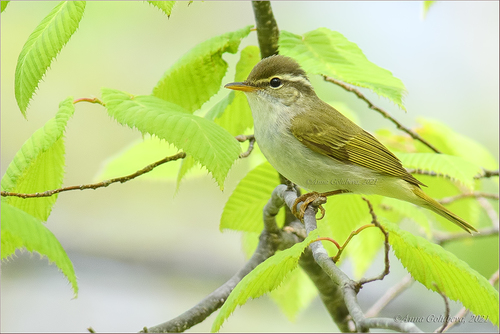
About Phylloscopus coronatus (Temminck & Schlegel, 1847)
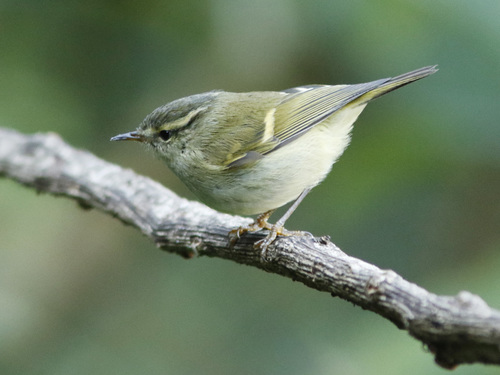
The eastern crowned warbler, with the scientific name Phylloscopus coronatus (Temminck & Schlegel, 1847), is a medium-sized, relatively robust, brightly coloured leaf warbler. Its upperparts are dark olive-green, and its underparts are white, with a distinct strong head pattern. This head pattern consists of dark grey lateral crown stripes and an indistinct yellowish median crown stripe. It also has a long yellowish-white supercilium, a dark stripe running through the eye, dark lores, and dusky yellow cheeks. It has one pale wingbar. Its square tail has a slight fork. The bill is quite strong, robust, and pale-coloured, and its legs are dark.
Eastern crowned warblers breed in eastern Siberia, ranging eastward from the Argun River and extending south into western Manchuria, central Sichuan, the Korean Peninsula, and Japan. They spend the winter in southeast Asia, from eastern India and Bangladesh to Java. The species has been recorded as a vagrant in western Europe; the first record for Great Britain was in County Durham in 2009, which was the fifth record of the species in the Western Palearctic, covering the UK and Scandinavia.
In terms of habitat and biology, the eastern crowned warbler inhabits open woodland — either mixed or deciduous woodland — at lower and middle mountain altitudes. In the northern part of its breeding range, it lives in dense taiga. Wintering eastern crowned warblers are found in open woodland, deep jungle, and mangroves. This is an arboreal species, but it forages quite low in vegetation. It joins mixed flocks of other small birds during both winter and the breeding season. The species is often detected by its frequent singing. It readily captures flying insects by flycatching, sallying out from a perch to catch insects in mid-air.