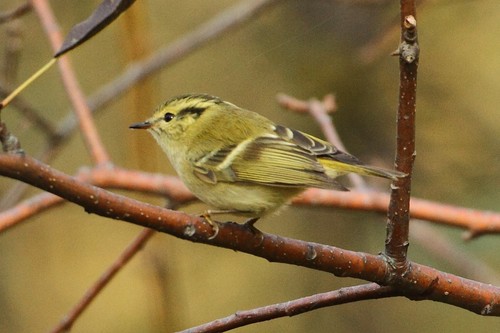
About Phylloscopus chloronotus (J.E.Gray & G.R.Gray, 1847)
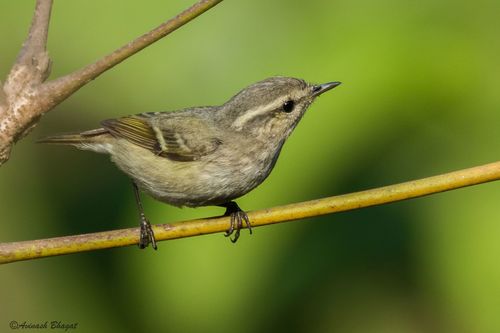
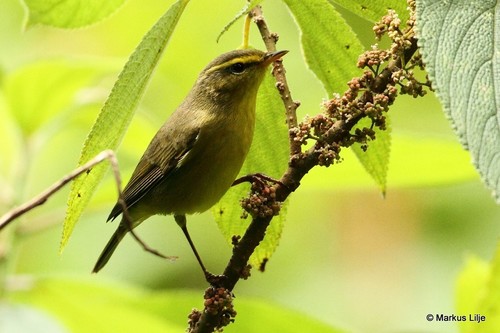
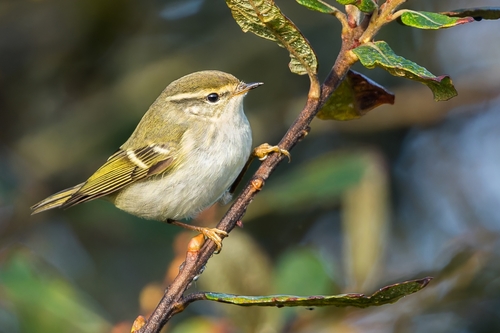
Lemon-rumped Warbler, whose scientific name is Phylloscopus chloronotus (J.E.Gray & G.R.Gray, 1847), measures 9–10 cm in length and weighs approximately 4.6–5.1 g. It has a whitish crown stripe bordered by darker olive-brown sides, a pale line above the eye, and a dark eyestripe that often curves downward. Its upperparts are greenish-grey, and its rump is yellowish or whitish, which is the source of the species' common name. The wings are grey-brown with green edging and usually display one or two pale wingbars. The underparts are whitish or buff, with some grey coloring along the sides of the breast. The bill is dark, with a yellowish or orange base on the lower mandible, and the legs are dark grey. Males and females have similar plumage, although females are slightly smaller. Juveniles look very similar to adults. Two subspecies are currently recognized: one occurs in the central and eastern Himalayas, and the other occurs in the western Himalayas, and the western subspecies has greener, more buff-toned plumage. This species breeds across the Himalayas, ranging from northern Pakistan through Nepal into India, Bhutan, and China. During winter, it moves down to lower elevations, reaching as far as Assam and occasionally Myanmar, but its reported presence in Afghanistan is unconfirmed. It lives in montane forests located between 2,200 and 4,200 meters above sea level. In Pakistan, it is most common at elevations of 2,200–2,700 m, while in Nepal its range extends up to 4,000 m. Winter records place the species between 300–2,700 m, generally above 1,000 m. Its breeding habitat includes spruce and fir forests with rhododendron and broadleaf trees, as well as oak and lower-elevation broadleaf stands located near the conifer zone.