About Phyllorhynchus decurtatus (Cope, 1868)
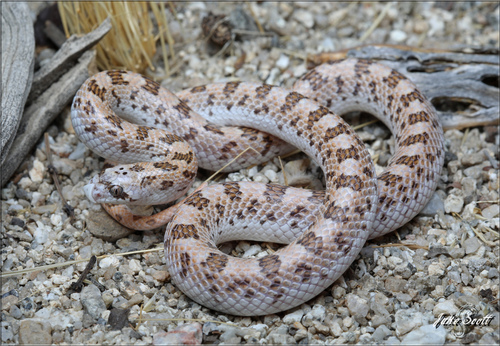
Phyllorhynchus decurtatus is a small snake, measuring between 150–450 mm (5.9–17.7 in) in total length. The dorsal half of its body varies in base color, but it is generally light brown; some individuals are cream, pink, or grey. Along the length of its back it has dark, irregular blotches, and the number of these spots varies between individual snakes and populations. Blotch markings occur in multiple shades of brown, with darker edges along their borders. There are between 18 and 60 blotches on the main body, and between 2 and 15 blotches on the tail. This species has a dark band that crosses both of its eyes, which have vertical pupils. It also has a large rostral scale, which gives it its common name of leafnose snake. The species’ range covers the southwestern United States, including the states of California, Nevada, and Arizona. Only one specimen has ever been recorded in southern Utah. In Mexico, it occurs along the coastline of the Gulf of California. Much of its range overlaps the Sonoran and Mojave deserts, and it is found in desert flatlands dominated by creosote bush. Its reproductive season runs from June to July, though specific breeding behaviors for this species have not been documented. Males are suspected to travel to search for females during this period, as they are encountered far more frequently between June and July. Females typically lay small clutches of three to four eggs, and hatchlings have the same patterning as adult individuals.