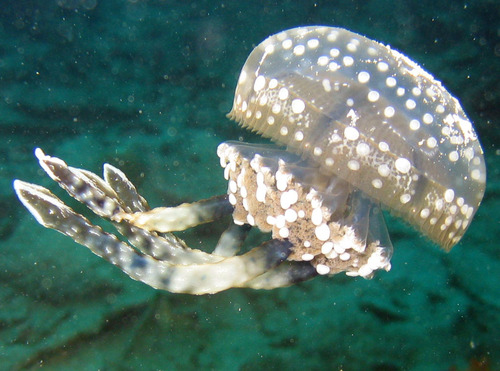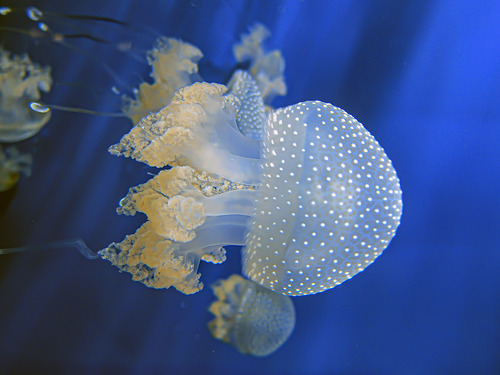
About Phyllorhiza punctata von Lendenfeld, 1884
This species, Phyllorhiza punctata von Lendenfeld, 1884, is a true jellyfish in the family Rhizostomatidae and the genus Phyllorhiza. Like other true jellyfish, it has a two-stage life cycle consisting of an adult medusa stage and a juvenile polyp stage. In the medusa (sexual) stage, male jellyfish release sperm into the water column. The female jellyfish collects this sperm through her mouth, where she holds her eggs. After fertilization produces larvae, the larvae leave the mother and settle onto the ocean floor. Once settled, they develop into the polyp form, which reproduces asexually via cloning, or dividing to produce additional polyps. This species can live up to five years in the polyp stage and up to two years in the active medusa stage. It flourishes in warm waters, and is mostly euryhaline, though low salinities have a negative effect on the species. When exposed to low salinity, P. punctata loses its zooxanthellae. Its local dispersal patterns are patchy. This jellyfish has only mild venom and is not considered a threat to humans. Its sting is mild or unnoticeable, and can be treated with dilute acid, most commonly white or cider vinegar. P. punctata is a filter feeder, because its venom is not potent enough to kill its prey. Its primary food source is zooplankton. These jellyfish typically travel in large groups, which can lead to large swarms that consume almost all zooplankton in the area. This causes detrimental harm to local ecosystems, as it leaves little food for other native species that rely on zooplankton. Feeding occurs through continuous filtration: fluid flows over clusters of mouthlets near the base of the oral arm disk in the center of the jellyfish's body, and the jellyfish must swim continuously to move prey to the different mouthlets for digestion. Its native range is centered around Cairns, Queensland, Australia, and Thailand, with its native habitat extending north from eastern Australia into Southeast Asia. It has also been recorded in non-native regions including Western Australia, the United States, the Atlantic Basin, Brazil, Puerto Rico, the eastern Mediterranean, New Zealand, the Caribbean, and the Gulf of Mexico. P. punctata prefers warm temperate seas, and aggregates in coastal waters. Reproduction in P. punctata follows the two-stage cycle described: the juvenile polyp stage is asexual, reproducing through repeated multiplication to produce a larger number of new individuals than the initial mother polyp. The sexually reproductive adult medusa stage follows the process outlined earlier, where fertilized larvae develop into polyps that drop to the ocean floor to grow and reproduce on their own.