About Phyllomyias griseiceps (P.L.Sclater & Salvin, 1871)
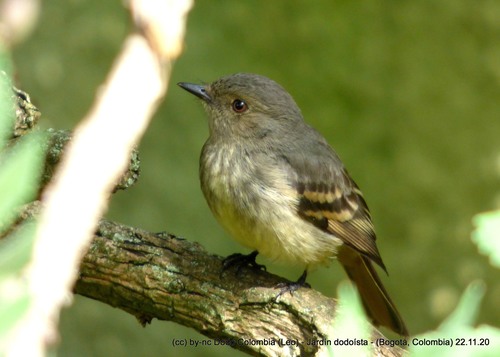
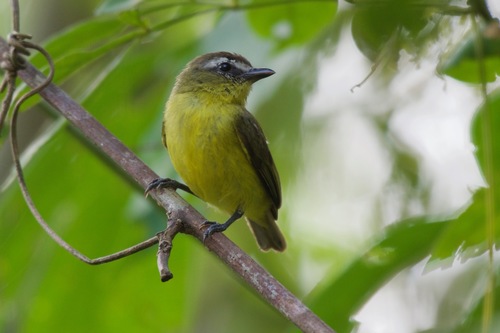
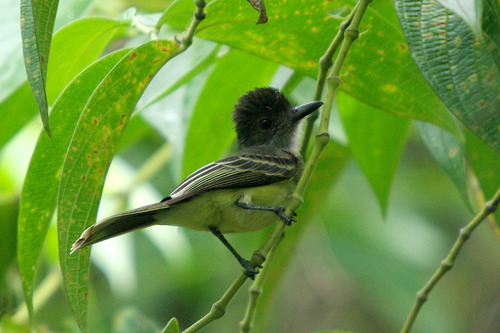
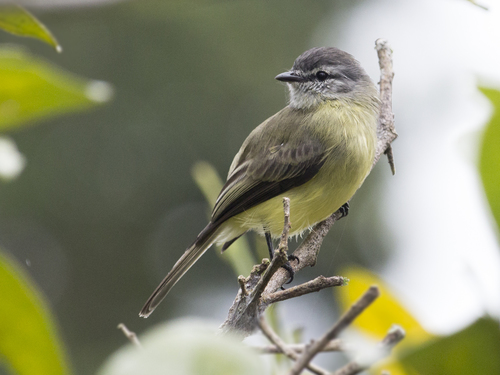
The sooty-headed tyrannulet, scientifically named Phyllomyias griseiceps (P.L.Sclater & Salvin, 1871), is approximately 10 cm (3.9 in) long and weighs around 8 g (0.28 oz). Males and females have identical plumage. Adult individuals have a grayish to blackish crown, with dull grayish olive coloration on the nape, back, and rump. Their lores and supercilium are white, marked by a dark stripe running through the eye. The lower face has a grizzled appearance. Their wings are dusky, with narrow whitish edges on the inner flight feathers and at the ends of the coverts. Their tail is dusky. The throat is grayish white, the breast and flanks are pale olive, and the belly is bright yellow. This species has a dark brown iris, a very small, rounded black bill, and black legs and feet. The sooty-headed tyrannulet has a highly disjunct distribution, with separate populations located in the following areas: extreme eastern Panama extending slightly into northwestern Colombia; the Sierra Nevada de Santa Marta in northern Colombia; the Serranía del Perijá along the Colombia-Venezuela border; from extreme southwestern Colombia south through western Ecuador to Loja Province; from southern Napo Province in Ecuador south to central Peru; the valleys of the Cauca and Magdalena rivers in Colombia extending into western and northern Venezuela; from eastern Venezuela east across Guyana and Suriname into French Guiana; and locally in southeastern Venezuela and northern Amazonian Brazil. The sooty-headed tyrannulet primarily lives in humid evergreen forest within the tropical zone. It avoids the forest interior, and instead favors forest edges, clearings with scattered trees, and regrowing partially cleared areas. It also occurs in other relatively open landscapes, including early succession secondary forest, forest growing on dry sandy soil, and coffee and cacao plantations. In terms of elevation range, it reaches up to 1,800 m (5,900 ft) in Colombia, 1,100 m (3,600 ft) in Ecuador, 1,200 m (3,900 ft) in Peru, 1,300 m (4,300 ft) in Venezuela, and around 500 m (1,600 ft) in the Guianas and Brazil.