About Phyllomyias fasciatus (Thunberg, 1822)
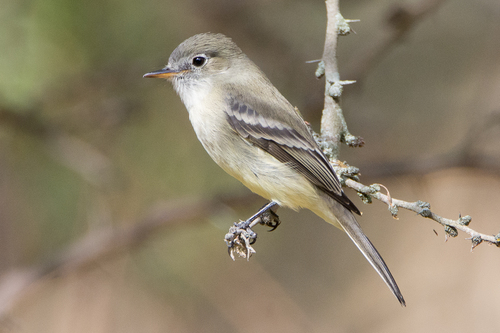
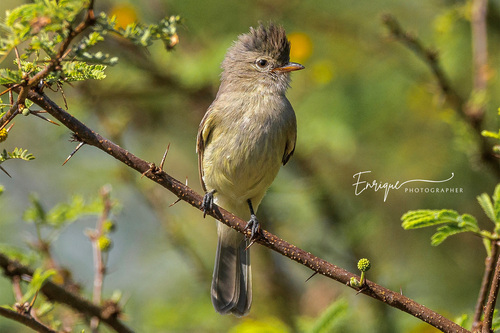
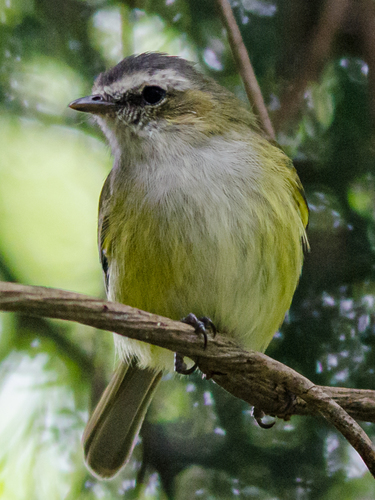
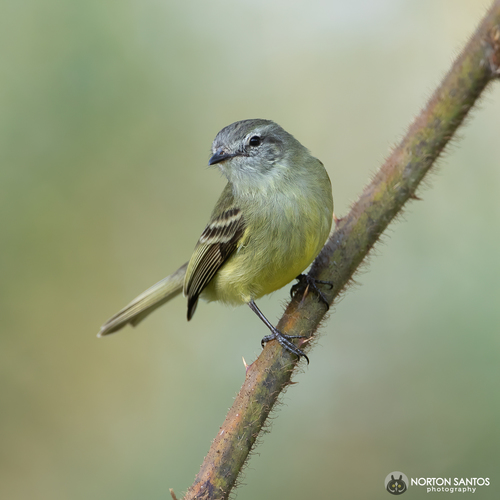
The planalto tyrannulet, Phyllomyias fasciatus, is 11 to 11.5 cm (4.3 to 4.5 in) long. Both sexes share identical plumage. Adults of the nominate subspecies have dull grayish-olive to brownish-olive crowns, napes, backs, and rumps, with the crown being the grayest area. Their lores, supercilium, partial eyering, and lower face are whitish, marked by a dark stripe through the eye. Their wings are dusky, with pale olive to whitish edges on the flight feathers and the ends of the coverts; the covert edges form two pale bars on the closed wing. Their tail is dusky. They have a whitish throat, and yellow underparts with an olive wash across the breast and sides. Subspecies P. f. brevirostris has darker olive upperparts than the nominate, with pale olive (rather than whitish) markings on the wings and wing coverts, a smaller white area on the throat, and darker yellow underparts. P. f. caerae is similar to brevirostris, but has a darker brown crown, duller upperparts with less yellow tones, and underparts with coloration between that of the other two subspecies. All subspecies have a brown iris, a short stubby blackish bill, and gray legs and feet. The nominate subspecies occurs in eastern Brazil, in a region roughly bounded by eastern Pará, western Bahia, southern Mato Grosso, and southern Goiás, and extends into extreme northeastern Bolivia's Santa Cruz Department. Subspecies P. f. brevirostris is found in southeastern Brazil from Minas Gerais and Espírito Santo south to Rio Grande do Sul, as well as in eastern Paraguay and northeastern Argentina's Misiones Province. P. f. caerae is located in northeastern Brazil, ranging from Ceará and Rio Grande do Norte south to Sergipe. This species mostly lives in humid tropical evergreen forest. It occurs less frequently in semi-deciduous woodland and gallery forest. Its elevation range spans from sea level to 1,800 m (5,900 ft), and it is most abundant between 500 and 800 m (1,600 and 2,600 ft).